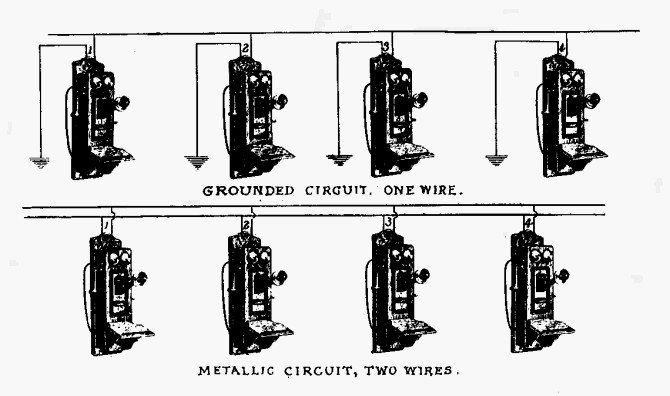
In the late 1800s and early 1900s, telephone circuits came in two basic types: A
“metallic” circuit was carried by a pair of wires throughout its entire length,
which provided a “metallic” circuit all the way, go and return. A “nonmetallic” or “grounded” circuit was carried by a single wire in one direction, and the return path was through the earth.
A “metallic” circuit usually consisted of two distinct wires carried on poles, but it could also consist of two single-conductor cables — laid underground or under water — along the same route, or two conductors in one cable (sometimes called a twin-core cable).
A “nonmetallic” circuit usually consisted of a single wire carried on poles, but it could also consist of a single-conductor cable (sometimes called a single-core cable). It was not unheard of for a “nonmetallic” telephone line in a rural area to be carried for substantial distances on fence posts; in some cases the telephone conductor was simply connected to the fence wire, and the fence wire itself served as part of the circuit. Some of these single-conductor telephone circuits survived into the late 1940s and early 1950s.
The main advantage of a “grounded” or single-wire circuit was the significantly reduced cost of building the line with only one wire, compared to the “metallic” circuit which required two wires all the way, thus doubling the quantity of metal wire and insulators and insulator support pins, and the increased construction labour.
The main disadvantage of the “grounded” or single-wire circuit, compared to the two-wire type, was the reduced quality of the audio signal delivered to the destination, mainly due to the ground-return's greater susceptibility to electrical interference from a variety of sources, both man-made (such as electric power lines, and electric railways which often cause large ground currents) and natural (such as what are now called magnetic storms), especially in regions where soil conditions made it difficult to get a “good” (low-resistance) ground connection for each telephone.
Above diagram illustrates the method of connecting “grounded” and “metallic” telephone circuits. It is reproduced from page 788 of the Report of of the Select Committee appointed to inquire into the Various Telephone Systems in Operation in Canada and Elsewhere, Session No. 24, May 17, 1905, held in Committee Room No. 20, House of Commons, Ottawa.

Note: The map shows the communication lines in orange. On the folded cover is the statement “500 miles and return in 5 minutes. The mail is quick; telegraph is quicker; but Long Distance Telephone is Instantaneous and you don't have to wait for an answer.” On the back of the map is a list of public pay stations. Folding into self wrappers 20x9.5 (inches), with “New York, Boston, Buffalo, Washington. Local and Long Distance Telephone. American Telephone and Telegraph Company. General Offices, 18 Cortlandt St. New-York. John C. Rankin Co., 34 Cortlandt St. N.Y.”
|
The Wayback Machine has archived copies of this document:
Archived: 1999 February 22
Archived: 1999 October 23
Archived: 2000 August 29
Archived: 2001 June 28
Archived: 2002 August 31
Archived: 2003 October 13
Archived: 2004 March 04
Archived: 2005 October 31
Archived: 2006 October 21
Archived: 2007 December 14
Archived: 2008 May 13
Archived: 2009 April 27
Archived: 2010 January 14
Archived: 2011 January 23
Archived: 2012 May 12
These links were accessed and found to be valid on 3 December 2013. |
 W3C HTML Validation Service http://validator.w3.org/ |
 W3C CSS Validation Service http://jigsaw.w3.org/css-validator/ |
First uploaded to the WWW: 1996 December 21
Script upgraded to HTML 4.0: 2001 November 30
Moved to new hosting service: 2010 October 10
Latest update: 2013 December 04
This webpage has been on the WWW
continuously for more than sixteen years.