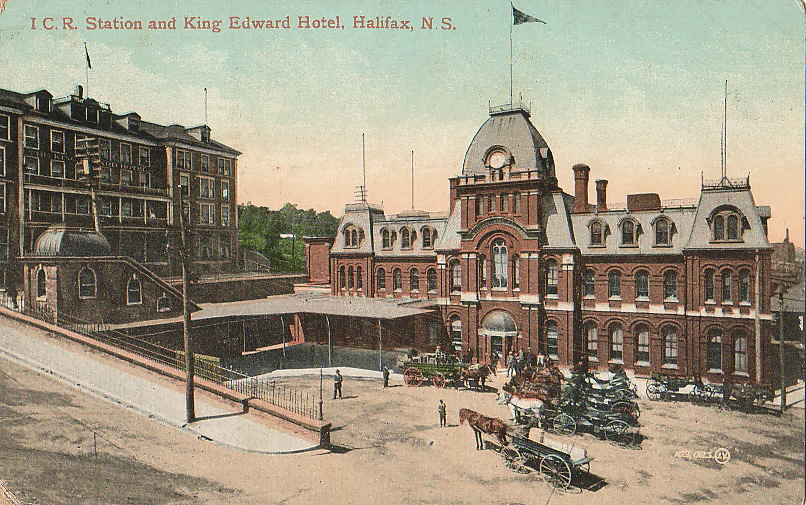
Intercolonial Railway's North Street Station, Halifax
1878-1917
The construction of the Intercolonial Railway
was the biggest Canadian public works project
of the nineteenth century.
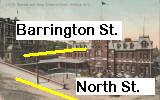
The Intercolonial Railway 1832-1876: Part One
The Intercolonial Railway 1832-1876: Part Two
Canadian Railroad Historical Association
Intercolonial Railway of Canada
The Chemistry Encyclopedia
Intercolonial Railway
The Quebec History Encyclopedia
Intercolonial Railway
Wikipedia
|
London, England 28 December 1861 The British Colonies in North America ...At the present moment* perhaps no subject is of so much interest and importance as the facilities for the transport of troops over from Halifax to Quebec. * The “present moment” (December 1861) was about nine months into the American Civil War – which had broken into active hostilities on 12 April 1861 when Confederate forces attacked Fort Sumter in South Carolina. In the British Colonies in North America, especially Nova Scotia, New Brunswick, Lower Canada (Quebec) and Upper Canada (Ontario) there was deep concern (with good reason) about the possibility of invasion in force from the south. The following statement, derived from a gentleman who has recently travelled through New Brunswick, from Quebec to Halifax, will be found interesting:– “On disembarking at Halifax the troops can be conveyed by rail to Windsor, Nova Scotia, about sixty miles [about 100km], from which point they can take steamers [steam powered ships] across the Bay of Fundy (which, contrary to popular ideas, is never frozen over) to St. Stephen's, a distance of about 170 miles [about 270km]. From St. Stephen's, a small town of about 4000 inhabitants, there is a railway open to Canterbury, twelve miles [20km] from Woodstock, one of the largest towns in New Brunswick. From Canterbury to Woodstock the distance can either be marched over a good snow road or performed in sleighs. From Woodstock a day's journey will convey the troops to Great Falls, a distance of 72 miles [116km], over excellent roads. From Great Falls the next stage is to Lake Port, a small place on the Temiscouta, and thence by sleigh over a very good new military road (which is kept open by the mail track three times a week, and by the operations of the lumberers), they will arrive at the Riviére du Loup. Forty-two miles [68km] of this latter portion of the journey, and during which the only practical inconvenience that will be experienced is through a forest district called the Portage, involving an ascent of upwards of 1000 feet [about 300m]. At all the points named the troops could be supplied with refreshments and lodgings in the houses, barns, and outbuildings. The only scarcity with regard to provisions is in the article of flour, as very little grain is grown in the district over which this route passes. There is, however, abundance of beef and other provisions. From the Riviére du Loup the troops will be conveyed by railway, a distance of 115 miles [185km], to Quebec...”— Illustrated London News, 28 December 1861 http://beck.library.emory.edu/iln/browse.php?id=iln39.1124.210 A Joint Project by Sandra J. Still, Emily E. Katt, Collection Management, and the Beck Center of Emory University, Atlanta, Georgia, U.S.A. |
|
London, England 28 December 1861 Reinforcements for Canada The Tower has lately been the scene of great bustle, owing to the preparations for sending military stores to Canada. Night and day, on Sundays as well as other days, men have been engaged packing arms, clothing, and other necessaries to a great amount, which are placed on sailing-barges moored alongside the quays; the stores are taken thence down the river, and shipped on board the transports now off Deptford and Woolwich. On the morning of Thursday week (19 December 1861) a great number of persons assembled at an early hour at the Wellington Barracks, St. James's Park, on the occasion of the departure of the 1st battalion of the Grenadier Guards and of the 2nd battalion of the Fusilier Guards for Canada. The 1st battalion of the Grenadier Guards, 800 strong, under the command of Colonel the Hon. Hugh Manvers Percy, C.B. (Victoria Cross), assembled, shortly after six o'clock, on the parade at the Wellington Barracks, preparatory to their departure for Southampton. After a due inspection, and after partaking of breakfast, at half-past seven o'clock the battalion left for the Waterloo station of the South-Western Railway. Owing to the death (14 December 1861) of the Prince Consort the regimental band did not accompany the battalion to the station. On their arrival at the terminus the men were told off in fours, and with the greatest facility – the system having been initiated by the late General Torrens – the train started at eight o'clock with its gallant burden; so that the entire battalion, each man carrying his rifle and a cooked ration, left quarters and started by railway to their destination within half an hour. The men were loudly cheered as they proceeded to the railway. The 2nd battalion of the Scots Fusiliers, of the same strength, commanded by Colonel William John Ridley, left the Wellington Barracks at eight o'clock, and pursued the same route – along Birdcage-walk, Great George-street, and across Westminster-bridge. The same excellent arrangements were observed, and without slightest confusion or delay the battalion departed at half-past eight o'clock for its destination. As the detatchments reached the docks on arriving at Southampton, they were received by the Southampton Volunteer Rifle Corps, and escorted to their respective ships by the band. The troops were cheered as they left the docks by an immense crowd of persons. The steamer Adriatic, with the Grenadier Guards, and the Parana, with the Scots Fusilier Guards and the eighteenth company of the Royal Engineers, left the docks about two o'clock in the afternoon and anchored in the river. Both vessels sailed for their destination early on the following morning. The Parana had a berth in the docks close to the Nashville, the Confederate man-of-war. As she was leaving her berth, with the Guards on board, the band struck up the tune, "I'm off to Charleston so early in the morning." The officers of the Nashville were watching the departure of the Parana with apparently considerable interest. Each soldier destined for Canada, on stepping on board of his transport, finds ready for him two pairs of woollen drawers, one jersey, two merino under-vests, two pair of worsted stockings, one comforter, one chamois leather waistcoat, one sealskin cap with ear-mufflers, one pair of sealskin mits, one pair of Canadian boots, and one sheepskin coat. The Royal Mail Company's steamer Magdalena, Captain Woolward, with the 16th Foot (about 1000 strong) on board, took her departure from Southampton last Saturday afternoon. She is under orders to sail for Halifax direct. The Cunard Company's Royal Mail steam-ship Asia, which sailed from Liverpool on Saturday for Halifax, carrying the mails for Newfoundland, Nova Scotia, New Brunswick, Canada, and other portions of North America, also took out about 470 military passengers, and nearly 200 tons of warm clothing, camp equipage, &c. The military arrived at Liverpool early on Saturday morning by special trains from Woolwich and Aldershott, and they were promptly conveyed in steam tenders to the Asia, lying at anchor in the Sloyne. The Asia sailed about 11:30am, with an easterly wind, and every prospect of making a rapid passage to Queenstown. Amongst the military passengers there were the staff for the army in Canada... The following further arrangements for the embarkation of troops for Canada have been completed: – the Hibernian will sail from Liverpool for New Brunswick, taking the fourth company of the Royal Engineers – 5 officers and 120 men; the G (Captian Hoste's) battery of the fourth brigade Royal Artillery, from Aldershott – 7 officers and 255 men; the sixth battery of the tenth brigade Royal Artillery (Captain Robinson's), from Woolwich – 6 officers and 117 men; a detachment of the first battalion 15th Foot – 4 officers and 147 men. The Canadian mail-steamer will take from Liverpool the seventh battery of the tenth brigade Royal Artillery (Captain Child's), from Woolwich – 6 officers and 117 men; and the eighth battery of the same brigade (Captain M'Rea's) – 6 officers and 117 men; the seventh battery for Halifax, the eighth for Newfoundland, the fifth company of the Royal Engineers for Bermuda – 4 officers and 100 men; and 6 men of the Army Hospital Corps for New Brunswick. The detachment of Royal Engineers under orders to embark in the Victoria will sail in the Calcutta. — Illustrated London News, 28 December 1861 http://beck.library.emory.edu/iln/browse.php?id=iln39.1124.215 A Joint Project by Sandra J. Still, Emily E. Katt, Collection Management, and the Beck Center of Emory University, Atlanta, Georgia, U.S.A. |
...The economic desirability of the Intercolonial Railway, viewed from whatever angle, was as great as ever. And by events of the winter of 1861-62 the old argument that it would be useful for defensive purposes had gained a new and effective point. The spectacle of some thousands of troops, sent from Britain after the Trent affair (8 November 1861), driving several hundred miles in sleighs in the depth of winter in order to reach the posts of need in Canada, was a dramatic revelation of the delays and perils involved in the then backward interprovincial communications. Thus, although the negotiations of the winter of 1861-62 had fallen through, hope of their renewal survived...
— page 444 of The Cambridge history of the British Empire, Volume 2:
The Growth of the new Empire, 1783-1870
by John Holland Rose, 1068 pages, Cambridge University Press, 1940
http://books.google.ca/books?id=yB49AAAAIAAJ&pg=PA444&lpg=PA444
...The American Civil War (1861-1865), fought between North and South over the issues of states rights and slavery, had a profound impact on British North America (BNA)... Despite the fact that nearly 40,000 people from BNA enlisted in Abraham Lincoln's Union armies in what they perceived to be a crusade against slavery, the colony itself was diplomatically aligned with the secessionist Southern states. That resulted simply because BNA, as a colony, was forced to follow the lead of its mother country, Britain. The mother country, going through the Industrial revolution and needing Southern cotton to supply its textile mills, proclaimed neutrality, but in many ways supported the Confederate states. That meant that British North America did so too. That was to have major consequences for the colony. At the war's conclusion, having supported the losing side, many felt that an invasion of retribution from the Northern armies was imminent, especially since the defenses of British North America were so small and scattered...
– Source: Causes of Confederation 1861-66
History of Canada Online, Northern Blue Publishing Inc.
|
London, England 4 February 1865 The British-American Confederation ...To carry out this general system of free trade, as well as to facilitate intercourse between the Maritime Provinces and Canada, it is absolutely necessary that the missing links of the intercolonial railroad, which is to connect Halifax with Quebec, be forthwith completed. These missing links are two – viz., between Truro, in Nova Scotia, and Shediac, in New Brunswick; and between Fredericton, N.B., and Riviere de Loup, the eastern terminus of the Grand Trunk line, 114 miles below Quebec. The construction of this line was recommended by Lord Durham in his celebrated "Report on the Affairs of British North America," so early as January 1839, at a time when the present gigantic system of American and Canadian railroads was yet in embryo. We quote this curious passage:– The completion of any satisfactory communication between Halifax and Quebec would, in fact, produce relations between these provinces that would render a general union absolutely necessary. Several surveys have proved that it would be perfectly practicable the whole way. It appears to be a general opinion in the United States that the severe snows and frosts of that continent very slightly impede and do not prevent the travelling on railroads; and, if I am rightly informed, the Utica Railroad, in the northern part of the State of New York, is used throughout the winter. If this opinion be correct, the formation of a railroad from Halifax to Quebec would entirely alter some of the distinguishing characteristics of the Canadas. Instead of being shut out from all direct intercourse with England during half the year, they would possess a far more certain and speedy communication throughout the winter than they now possess in summer. The passage from Ireland to Quebec would be a matter of ten or twelve days, and Halifax would be the great port by which a large portion of the trade, and all the conveyance of passengers to the whole of British North America, would be carried on... If the great natural channel of the St. Lawrence gives all the people who dwell in any part of its basin such an interest in the government of the whole as renders it wise to incorporate the two Canadas, the artificial work which would, in fact, supersede the lower part of the St. Lawrence as the outlet of a great part of the Canadian trade, and would make Halifax, in a great measure, an outport to Quebec, would surely, in the same way, render it advisable that the incorporation should be extended to provinces through which such a road would pass. Although Sir Robert Peel's Government was favourable to this project, and offered to guarantee 4 per cent interest to the investors, it has not yet been carried out. The want of it was grievously felt by the empire in the winter of 1861-62, when the 10,000 British troops made their famous passage on sleighs between Fredericton and Quebec. The same motives of economy and speed in the conveyance of troops, military stores, and the mails which have prompted the Indian Government to guarantee a certain rate of interest upon the vast sums invested in Indian railroads, has at length impelled both the Imperial and Colonial Governments to renew their offers of a guarantee and grant of land to any capitalists who will supply the missing links in the railroad chain between Halifax and Quebec. As the surveys have long since been made, and the estimated outlay is only £3,000,000 for a length of 350 miles, and inasmuch as its execution is a condition precedent of the proposed Confederation, we may soon expect to hear of its introduction on the Stock Exchange... — Illustrated London News, 4 February 1865 http://beck.library.emory.edu/iln/browse.php?id=iln46.1300.005 A Joint Project by Sandra J. Still, Emily E. Katt, Collection Management, and the Beck Center of Emory University, Atlanta, Georgia, U.S.A. |
By January 1862, the diplomatic wrangling between the United States and Britain over the Trent Affair had eased somewhat. British troops, however, were still journeying across New Brunswick to reinforce the defences of central Canada. Local newspapers noted the size and numbers of the troop movements. On January 31, 1862, the New Brunswick Reporter noted that seven hundred “Great Guns” were moving from Saint John through Fredericton and on to Woodstock. A few days later, the same newspaper reported the passage of upwards of forty teams of troops and two hundred horses. By March 1862 the soldiers' barracks in Fredericton needed to be expanded to accommodate the volume of troops passing through the city. The troops' journey could not have been pleasant in the depth of winter... The Headquarters, another Fredericton newspaper, noted in January 1862 that two soldiers were hospitalized with severe frostbite after arriving in Fredericton from Saint John. The paper also noted that often the soldiers, who had been packed in sleighs for four or five hours between scheduled stops, arrived in Fredericton to cold barracks and having to wait twelve hours for food... Winter troop movements were unexpectedly easier than those in other seasons because the frozen waterways provided more direct routes and smoother passages for the sleighs.
— McCord Museum, Montreal
http://www.mccord-museum.qc.ca/scripts/viewobject.php?section=162&Lang=1&tourID=VQ_P1_7_EN&seqNumber=4
1846: Railway between Nova Scotia and Canada
sixteen documents written in 1846
about the proposed railway
between Halifax and Quebec
http://ns1758.ca/rail/railway1846.html
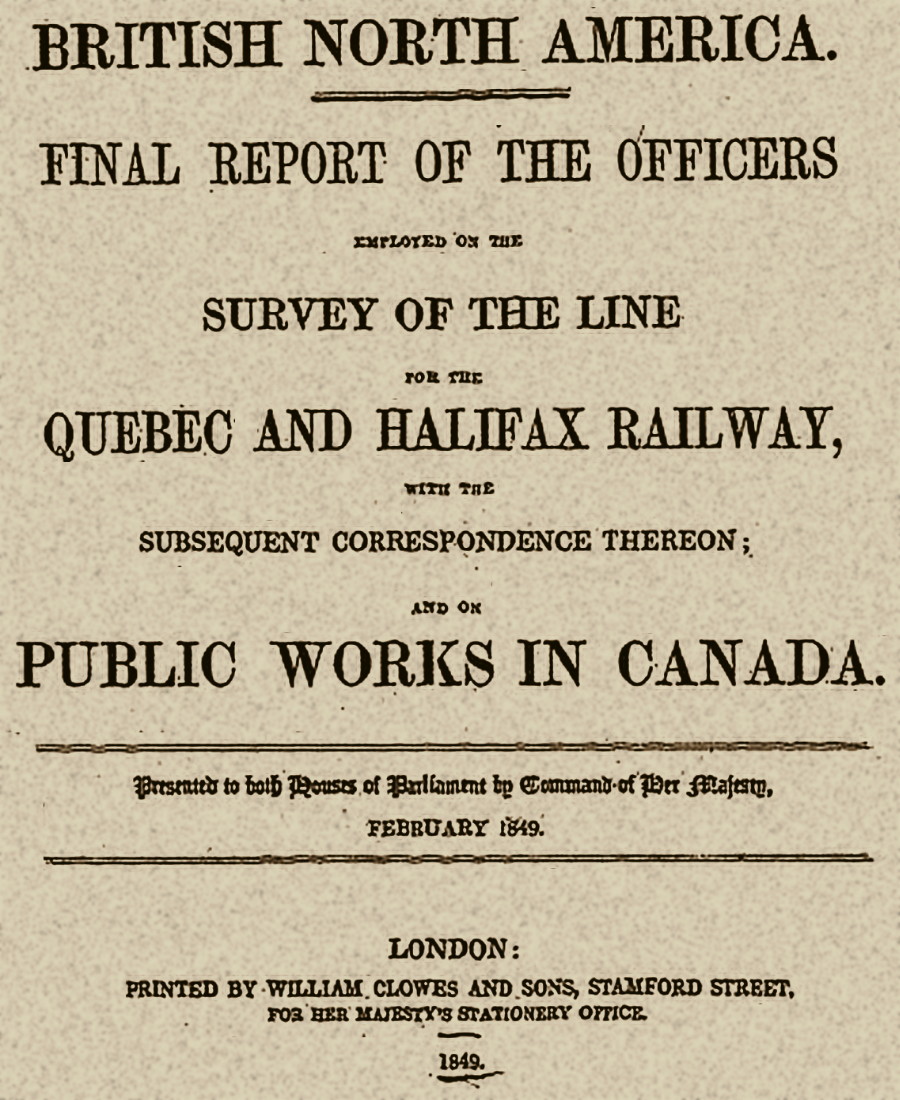
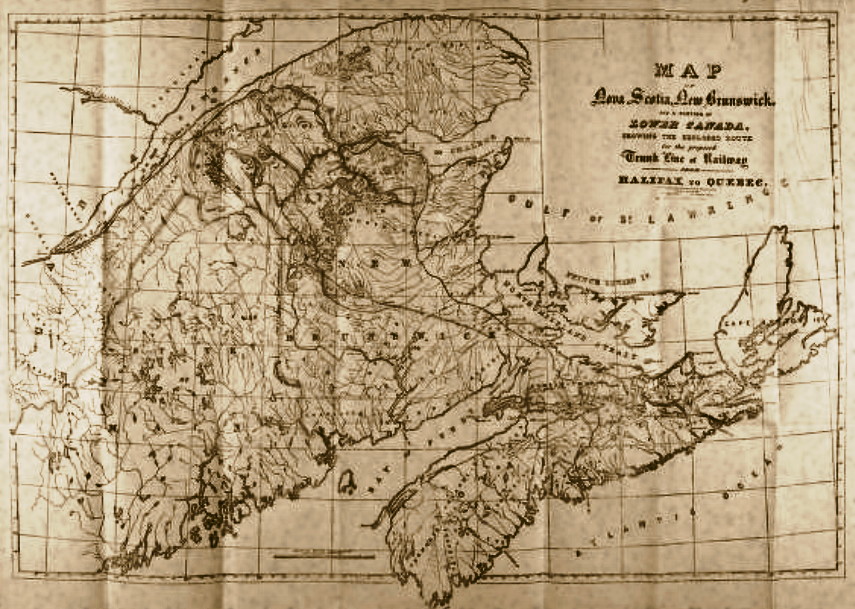
The astonishing speed at which the revolutionary new
steam-powered railway technology spread across the
world is clearly demonstrated by this “final report of
the officers employed on the survey of the line for the
Quebec and Halifax Railway,” published barely twenty
years after the famous Rainhill Trials in England in
October 1829 – the event accepted by many as marking
the beginning of the modern world. In those twenty years,
knowledge of this new technology spread across the
Atlantic Ocean and became known to enough influential
people in faraway Canada that a decision was made to
undertake a careful survey to find a satisfactory route
for a railway across 600 miles [1000 km] of mostly
wilderness – then to complete the survey,
followed by the writing, printing and
publication of this detailed report.
|
More historic documents
about Nova Scotia railways archived online |
|
More historic documents
about Nova Scotia railways archived online |
|
More historic documents
about Nova Scotia railways archived online |
| ||||||||||||||||||||||||||||||||||||||||||||||||||||||||||||||||||||||||||||||||||||||||||||||||||||||||||||||||||||||||||||||||||||||||||||||||||||||||||||||||||||||||||||
The favourite route from Quebec to the Maritime Provinces is by the Intercolonial Railway, which runs down the south shore of the St. Lawrence River as far as Rimouski, and then turns south... The three Maritime Provinces of Canada are Nova Scotia, New Brunswick, and Prince Edward Island, and the Intercolonial Railway traverses them all. It is a government road, admirably built and equipped, and most moderate in its charges... The cars on through express passenger trains are lighted by electricity and heated by steam from the locomotive. The head offices of the railway are at Moncton... The fare by rail between Quebec and Halifax is $14.00 one way, $21.00 return...
From "The Canadian Guide Book: The Tourist's and Sportsman's Guide to Eastern Canada..." (page 111)
1891, by Charles G.D. Roberts, Professor of English Literature at King's College, Windsor, Nova Scotia

     Date of
    first run

    1 Mar 1898    The Maritime Express   Montreal - Halifax
    3 Jul 1904    Ocean Limited          Montreal - Halifax
   26 Jun 1927    The Acadian            Montreal - Halifax
   28 Jun 1929    Down Easter            New York - Halifax
   28 Jun 1929    Pine Tree Acadian      Boston - Halifax
    2 Mar 1930    The Gull               Boston - Maritime Provinces
   16 Mar 1941    The Scotian            Montreal - Halifax
   14 Jul 1956    The Bluenose           Edmonton - Halifax
    1 Jun 1967    The Cabot              Montreal - Sydney
Members of the Scotian Railroad Society are to be commended on their choice of a name for the newsletter which will record their proceedings and the progress of their efforts to keep alive the legends and traditions of the old steam railways of the Atlantic Region. Nothing could be more typical of this part of Canada than The Maritime Express, the first name train to operate in Canada east of Montreal.
When the Intercolonial Railway opened for traffic between the Maritimes and Quebec on June 30 - July 2, 1876, the passenger train which was to become The Maritime operated over the ICR proper only from Moncton to Riviere du Loup, thence over Grand Trunk iron to the Quebec city ferry wharf at Levis.
Northbound passengers came up from Halifax on old No. 1 express of the original Halifax - Saint John main line to Moncton, where they were joined by Saint John passengers ex No. 2, and all transferred to the North Shore train. On the return trip the procedure was reversed.
Some years later when sleeping cars were introduced, they started on alternate days from Halifax and Saint John. That is, on a Halifax night the passengers from Saint John rode the day coaches to Moncton and there took up reservations on the sleeping car from Halifax. Next day, the Haligonians rode the day coaches and boarded the sleeper from Saint John at Moncton.
Just when the whole train began to run east of Moncton no one I have consulted seems to know, or when the Maritime Express officially replaced Halifax Express (eastbound) and Quebec Express (westbound). There is nothing about it in the federal papers I have examined, but a search of old newspapers and timetables might turn it up, and this would make a worthy assignment for our historically minded members.
I am not sure that the names were ever officially adopted by the road, but the eastbound train was popularly known as the Halifax Express and the westbound as the Quebec Express. In time these names also came to be applied loosely to Nos. 1 and 2 on the old main line, although only the sleeper actually ran through.
The locomotives were small eight wheelers and the passenger cars were of the open platform type, with link and pin couplers and "Armstrong" (hand) brakes. Closed vestibule cars were not provided until late in the 1890s, although air brakes had been installed in 1886. The train was a pioneer in the electric lighting of passenger cars. At first this was a clumsy system worked by storage batteries, which eventually gave way to pintsch gas lights, which in turn was superseded first by electric lights powered by steam-driven dynamos on the locomotives, and later by electric batteries in each individual car that were recharged by a generator driven by a belt from an axle...
The Maritime of necessity did much local work which greatly slowed her average speed, and in 1904 Hon. Henry R. Emmerson, of pious and immortal memory, supplemented her with a faster through summer train which a public voting contest named the Ocean Limited, and which eventually operated the year round...
Through the 1950s The Maritime Express slowly declined. After working in various combinations with other name trains, in the mid-1960s she finally wound up as she had started in 1872 — handling local traffic between Moncton and Montreal. In 1967 she vanished from the schedule.
— The above is excerpted from The Maritime Express, v1 n1, June 1968, (the first issue). This newsletter was published quarterly by the Scotian Railroad Society, Halifax.
| ||||||||||||||||||||||||||||||||||||||||||||||||||||||||||||
| ||||||||||||||||||||||||||||||||||||||||
Note 3: The Pictou Town Branch of the ICR ran between Stellarton and the Town of Pictou.
The Pictou Landing Branch of the ICR ran from Trenton to Pictou Landing in Pictou County.
| ||||||||||||||||||||||||||||||||||||||||||||||||||||||||||||||||||||||||||||||||||||||||||||||||||||||||||||||||||||
Note 3: In May 1955 the track between Linwood and Mulgrave suddenly lost almost all of its traffic, because all railway traffic to and from Cape Breton Island was diverted to the newly-completed Canso Causeway. The remainder of the "Port Mulgrave Branch" remained in use as the main line between Truro and Sydney, and in 2013 — owned now by the Cape Breton and Central Nova Scotia Railway — continues to carry trains daily.
| ||||||||||||||||||||||||||||||||||||||||||||||||||||||||||||||||||||||||||||||||
Note 3: In the 1880s and 1890s the ICR main line track between Point Tupper and Sydney was located along the same route it occupies in 2013 (now as the main line of the Cape Breton & Central Nova Scotia Railway), except between Georges River and Leitches Creek, which was relocated (about 1920?) to eliminate the steep grades in this section of the original track. This relocation altered the track distances and station locations (mileages) beyond Georges River.
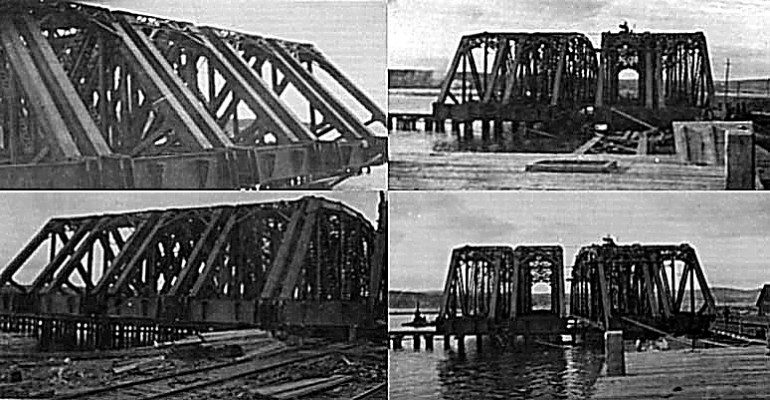
Building the Grand Narrows Bridge
Cape Breton's Magazine, number 23, page 15
Published at Wreck Cove by Ronald Caplan, 1 Aug 1979
NOTE: the reference to a “cantilever” bridge is a mistake.
The Grand Narrows bridge is not a cantilever bridge.
Every Bridge Tells a Story by Jay Underwood
(The Story of the Grand Narrows Bridge)
Canadian Rail Magazine n499
March-April 2004, pages 43-47
Grand Narrows Bridge
Wikipedia
Job Abbot (1845-1896)
Dominion Bridge Company Limited, Montreal
Dominion Bridge built “the low level... Grand Narrows Bridge
at Iona, Nova Scotia, for the Intercolonial Railway”
STRUCTURE magazine, April 2012
National Council of Structural Engineers Associations (NCSEA)
Job Abbott (1845-1896)
President and chief engineer
Dominion Bridge Company Limited, Montreal
Dominion Bridge built “the Grand Narrows Bridge on Cape Breton” Island
Dictionary of Canadian Biography Online
| ||||||||||||||||||||||||||||||||||||||||||||||||||||||||||||||||||||||||
Note 3: This railway line, between Oxford Junction in Cumberland County and Brown's Point in Pictou County, was known as the "Short Line" from the earliest days of construction in the 1880s until the last train ran in October 1994. The reason for this name was simple: the line was promoted and surveyed, and the initial construction contracts were let, by the Montreal & European Short Line Railway Company, later the Great European and North American Short Line Railway Company.
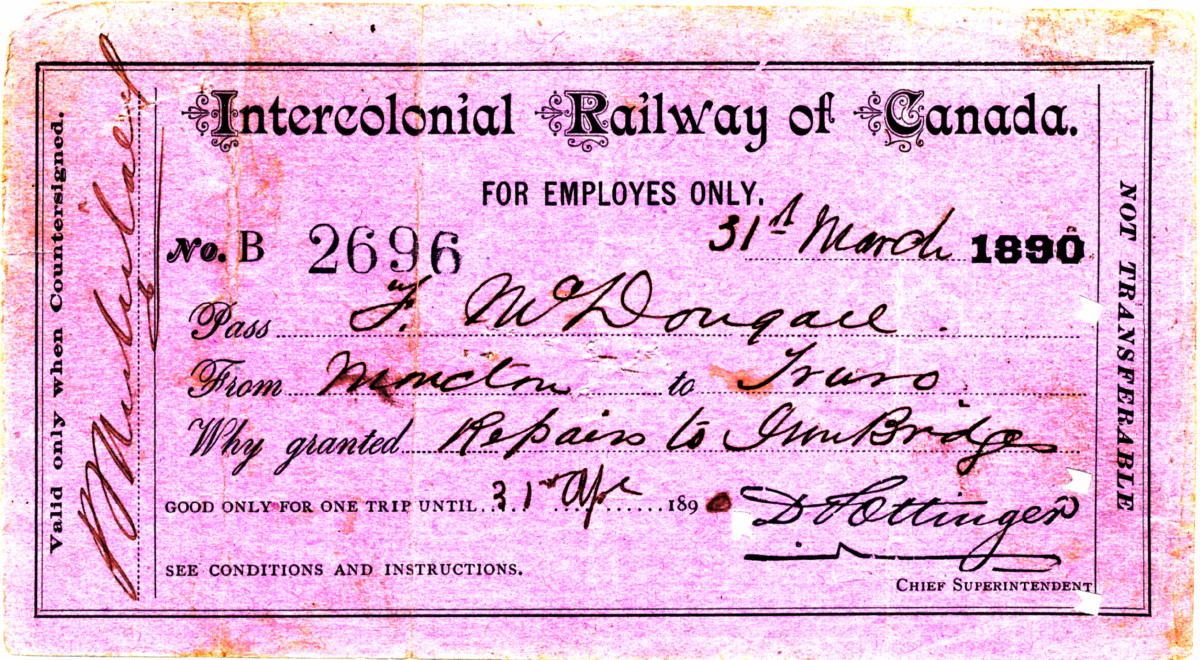
Front (above) Back (below)
Subject: Surveying the Intercolonial Railway main line
between Truro and Amherst in Nova Scotia.
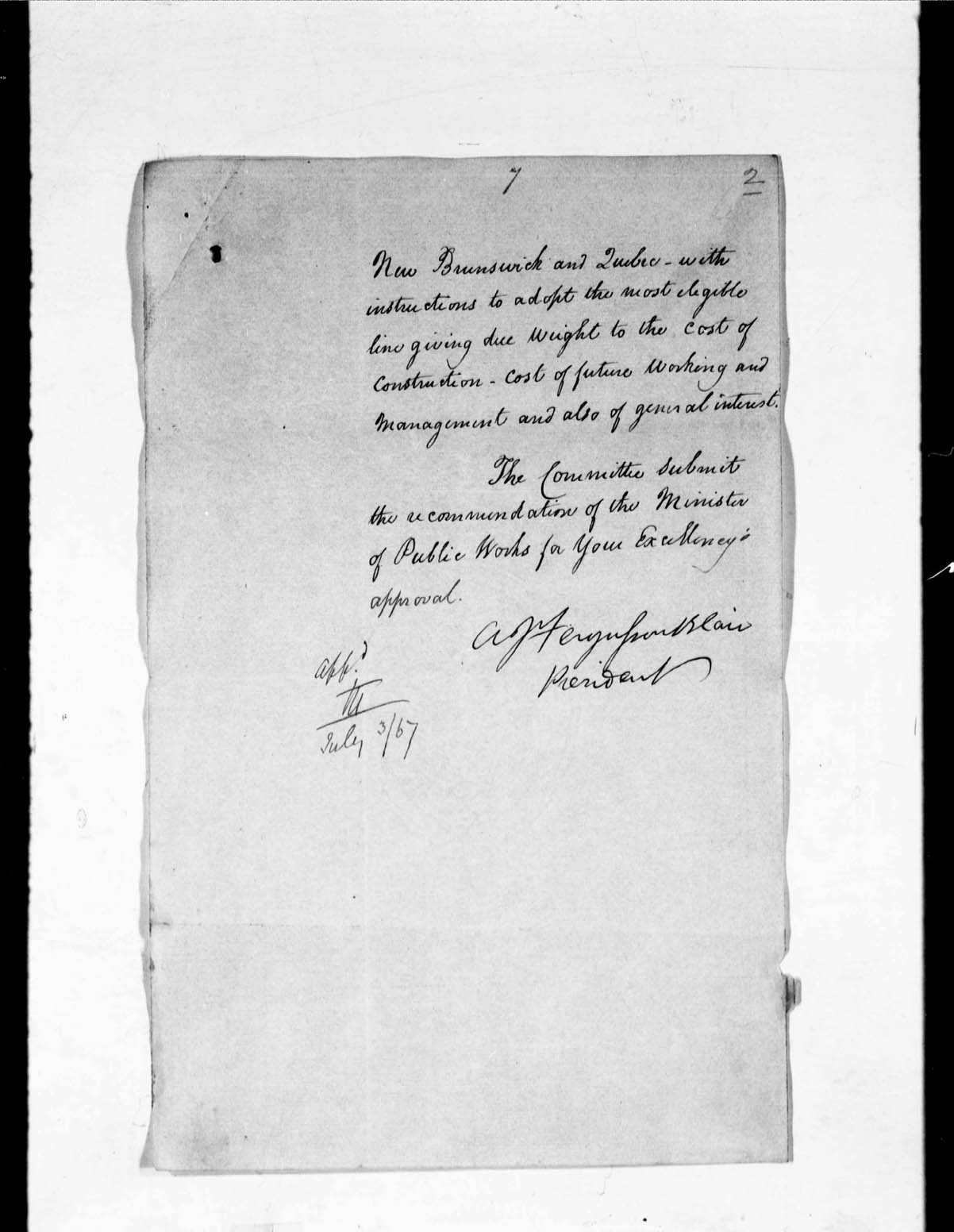
OIC 1867-0007, page 1
OIC 1867-0007, page 2
OIC 1867-0007, page 3
On a memorandum dated July 3rd, 1867, from the Hon. the Minister* of Public Works stating that the government of Nova Scotia caused a detailed exploration of the Country lying between Truro and the Nova Scotia boundary near Amherst to be made – with a view of selecting the best site for the proposed Intercolonial Railway. That in May 1866 W. Sandford Fleming, the Engineer employed to make this Survey, reported that he had examined all the practicable Railway lines between these two points, and recommended one of the explored lines as preferable in its main features to the others...
— Source:
Ottawa, Federal Government Orders in Council
http://www.collectionscanada.gc.ca/databases/orders/001022-100.01-e.php
* The Hon. William McDougall (1822-1905)
was Minister of Public Works
from 1 July 1867 to 27 September 1869.
Subject: [Minister of Public] Works Railways of Nova Scotia and New Brunswick to be placed under the control of the Department of [Public] Works of the Dominion of Canada.
OIC 1867-0082, page 1
OIC 1867-0082, page 2
On a memorandum dated 8th inst. from the Hon. Minister of Public Works submitting that the Act for the Union of Canada, Nova Scotia and New Brunswick of 1867 provided that the Railways and Railway Stocks of each province shall be the property of the Dominion and stating that up to the date of the Proclamation of the said Act – viz. the 1st July 1867 – certain Railways of Nova Scotia and New Brunswick were the property of and were operated and managed by the respective Governments of these Provinces. That since the 1st July 1867 the aforesaid Railways have been managed by the officers in charge and recommending that immediate provision be made by Your Excellency for placing these Railways and their appurtenances under the control of the Department of Public Works of the Dominion of Canada, with the authority to manage the working, and administer the affairs thereof...
— Source:
Ottawa, Federal Government Orders in Council
http://www.collectionscanada.gc.ca/databases/orders/001022-100.01-e.php
Subject: [Minister of] Customs Claim of Mr Joseph Nelson, London, England — For services in securing Imperial Guaranter [Guarantee] to Loan of £3,000,000 [Sterling] for construction of Intercolonial [Railway] - Mr Nelson to be paid £300
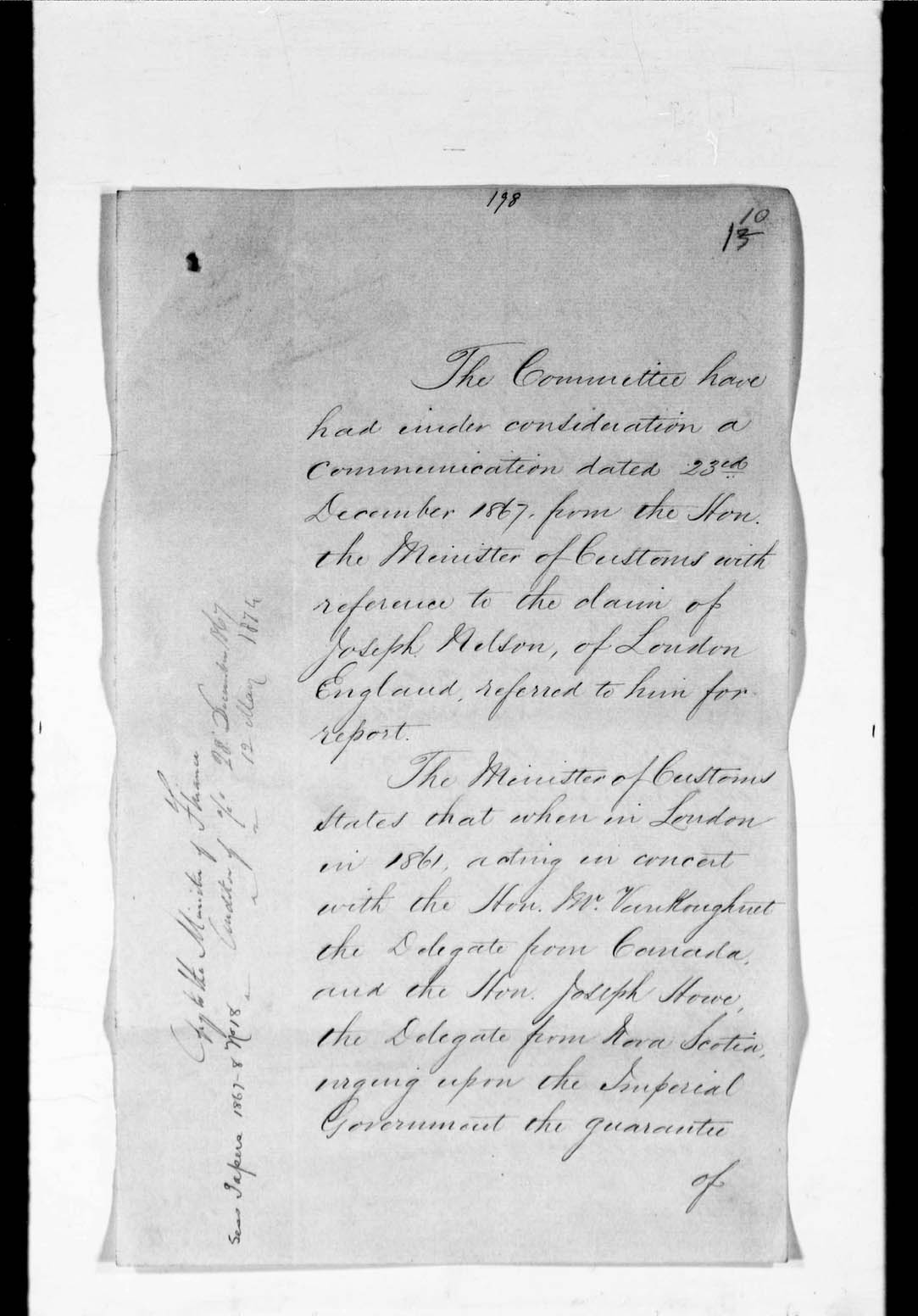
OIC 1867-0198, page 1
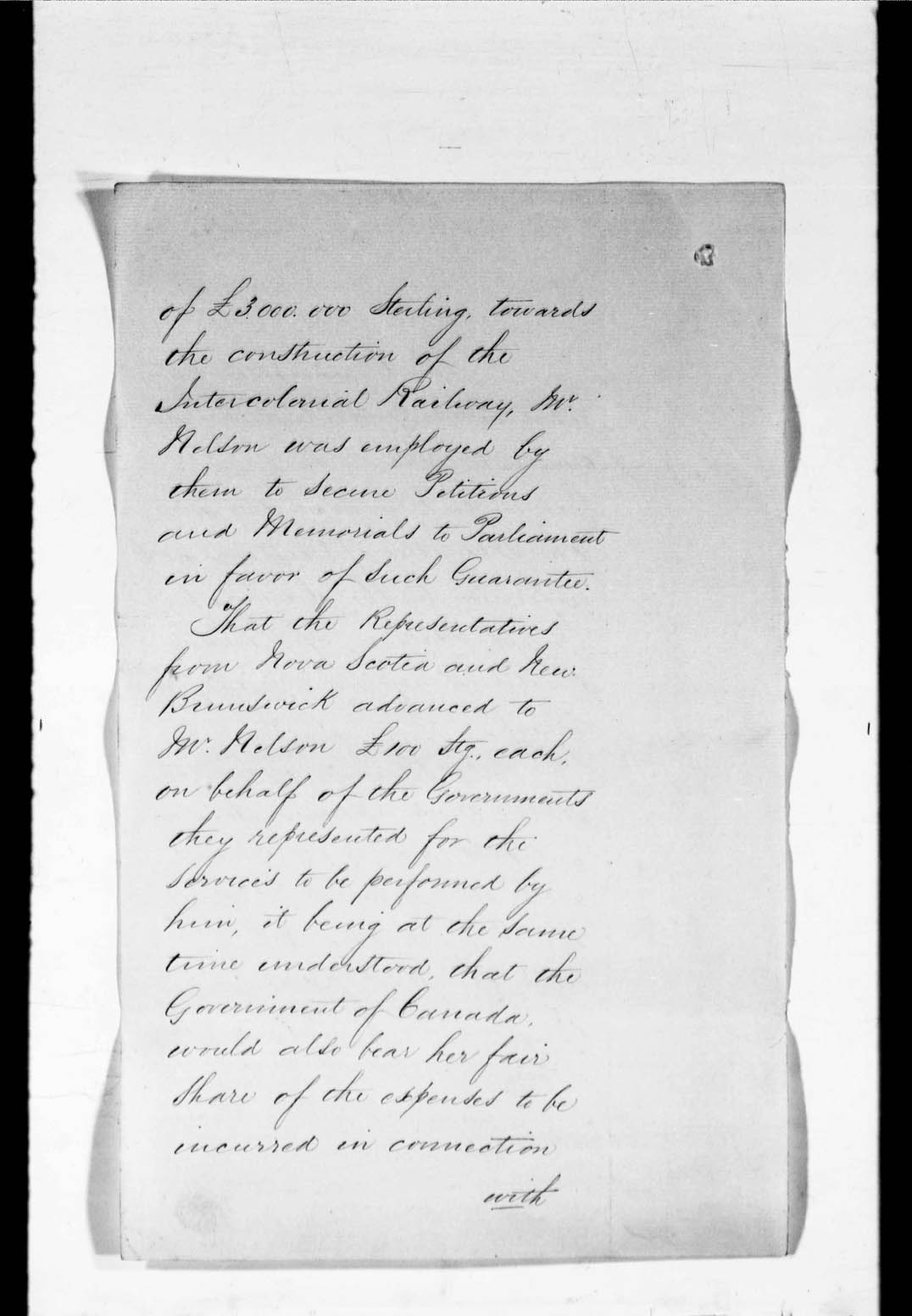
OIC 1867-0198, page 2
OIC 1867-0198, page 3
The Committee have had under consideration a Communication dated 23rd December 1867, from the Hon. the Minister* of Customs with reference to the claim of Joseph Nelson, of London, England, referred to him for report. The Minister of Customs stated that when in London in 1861, acting in concert with the Hon. Mr. VanKoughnet the Delegate from Canada and the Hon. Joseph Howe, the Delegate from Nova Scotia, urging upon the Imperial Government the guarantee of £3,000,000 Sterling towards the construction of the Intercolonial Railway. Mr. Nelson was employed by them to secure Petitions and Memorials to Parliament in favor of such Guarantee...
— Source:
Ottawa, Federal Government Orders in Council
http://www.collectionscanada.gc.ca/databases/orders/001022-100.01-e.php
* The Hon. Samuel Leonard Tilley (1818-1896)
was Minister of Customs
from 1 July 1867 to 21 February 1873.
Subject: Minister of Public Works – Survey of the Intercolonial Railway between Truro and Amherst, Nova Scotia $30,000 placed at disposal of the Minister to pay Mr. Sandford Fleming salary and expenses...
OIC 1868-0307, page 1
OIC 1868-0307, page 2
On a memorandum dated February 24, 1868, from the Hon. the Minister of Public Works submitting for the information of Your Excellency that Mr. Sandford Fleming, the Engineer appointed under the authority of an Order in Council dated the 3d of July 1867 to make the location survey of the Intercolonial Railway which lies between Truro and Amherst in Nova Scotia, has completed the survey in question and has forwarded his Report with plans &c of said Survey to his Department. That Mr. Fleming has carried out this Survey with his own funds and now submits a Statement of his expenditure thereupon with Vouchers. That the sum so expended amounts to $26,804.56 and recommending...
— Source:
Ottawa, Federal Government Orders in Council
http://www.collectionscanada.gc.ca/databases/orders/001022-100.01-e.php
Subject: Minister of Public Works — To expend $9000 for construction purposes on the Nova Scotia Railway
OIC 1868-0503, page 1 of 1
The Committee on the recommendation of the Hon. the Minister of Public Works dated 16th May 1868 advise that he be authorized to expend the sum of Nine thousand dollars for construction purposes on the Nova Scotia Railway viz:
To finish Wharf at Richmond* $3000...
— Source:
Ottawa, Federal Government Orders in Council
http://www.collectionscanada.gc.ca/databases/orders/001022-100.01-e.php
* “Richmond” refers to an area in north Halifax,
along the west side of Halifax Harbour.
Subject: Minister of Public Works — $30,000 placed at his disposal to procure Locomotives for the Nova Scotia Railway
OIC 1868-0614, page 1 of 1
On a Memorandum dated 10th June 1868, from the Hon. the Minister of Public Works requesting authority to proceed with the construction of two locomotives for the use of the Nova Scotia Railway and that a sum of Thirty thousand dollars ($30,000) be placed at his disposal for the purpose...
— Source:
Ottawa, Federal Government Orders in Council
http://www.collectionscanada.gc.ca/databases/orders/001022-100.01-e.php
Subject: Minister of Public Works — Respecting the construction of two locomotive Engines for the Nova Scotia Railway - Contract to be entered into with the Canadian Engine and Machinery* Company
OIC 1868-0707, page 1
OIC 1868-0707, page 2
On a Memorandum dated 6th July 1868, from the Hon. the Minister of Public Works reporting with reference to the Order in Council of the 15th ultimo, authorizing him to direct the construction of two Locomotive Engines for the Nova Scotia Railway, and placing a Sum of $30,000 at his disposal for that purpose. That the Canadian Engine and Machinery* Company, doing business at Kingston, Province of Ontario, offer to build the two Engines according to Specification approved by the Engineers of the Department for the sum of Thirteen thousand dollars ($13,000) each, and recommending that this Tender be accepted...
— Source:
Ottawa, Federal Government Orders in Council
http://www.collectionscanada.gc.ca/databases/orders/001022-100.01-e.php
* The Canadian Engine and Machinery Company,
predecessor of the Canadian Locomotive Company,
was founded in 1865 from the assets of the
bankrupt Kingston Locomotive Works.
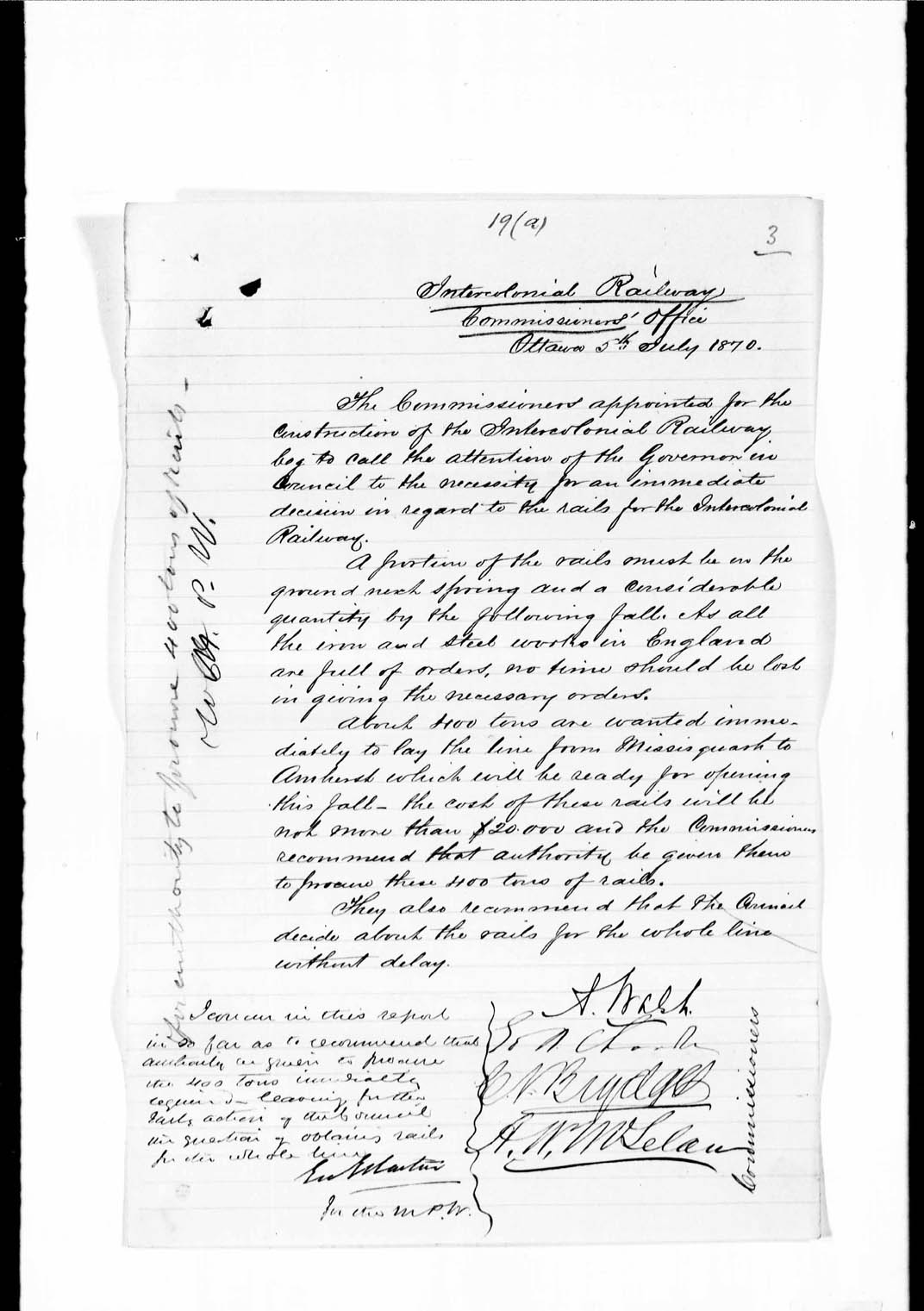
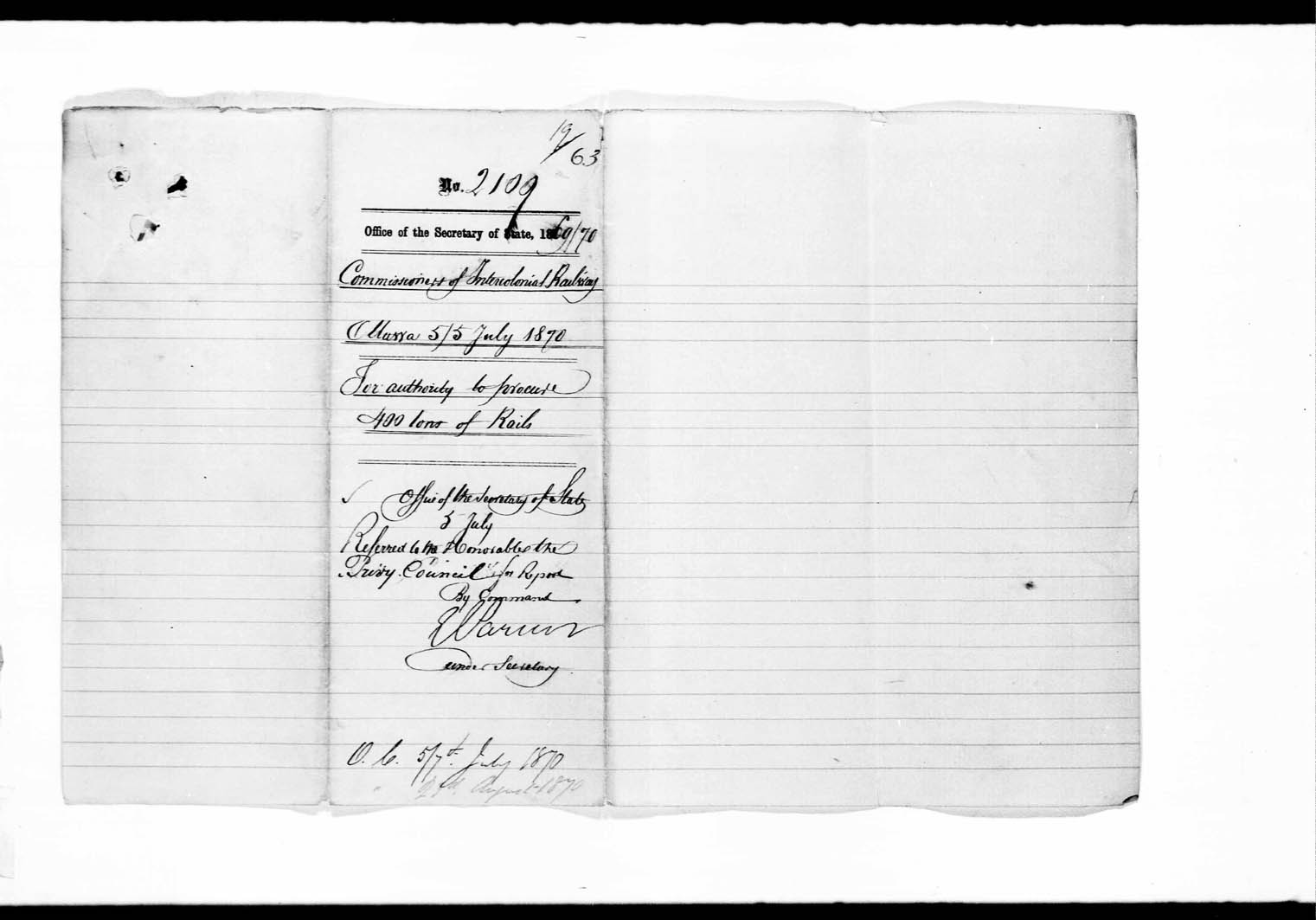
Subject: Intercolonial Railway — [Acting] [Minister of Public] Works [recommended] that [Committee] be authorized to procure 400 tons of rails for the new Intercolonial Railway line from Missisquash* to Amherst...
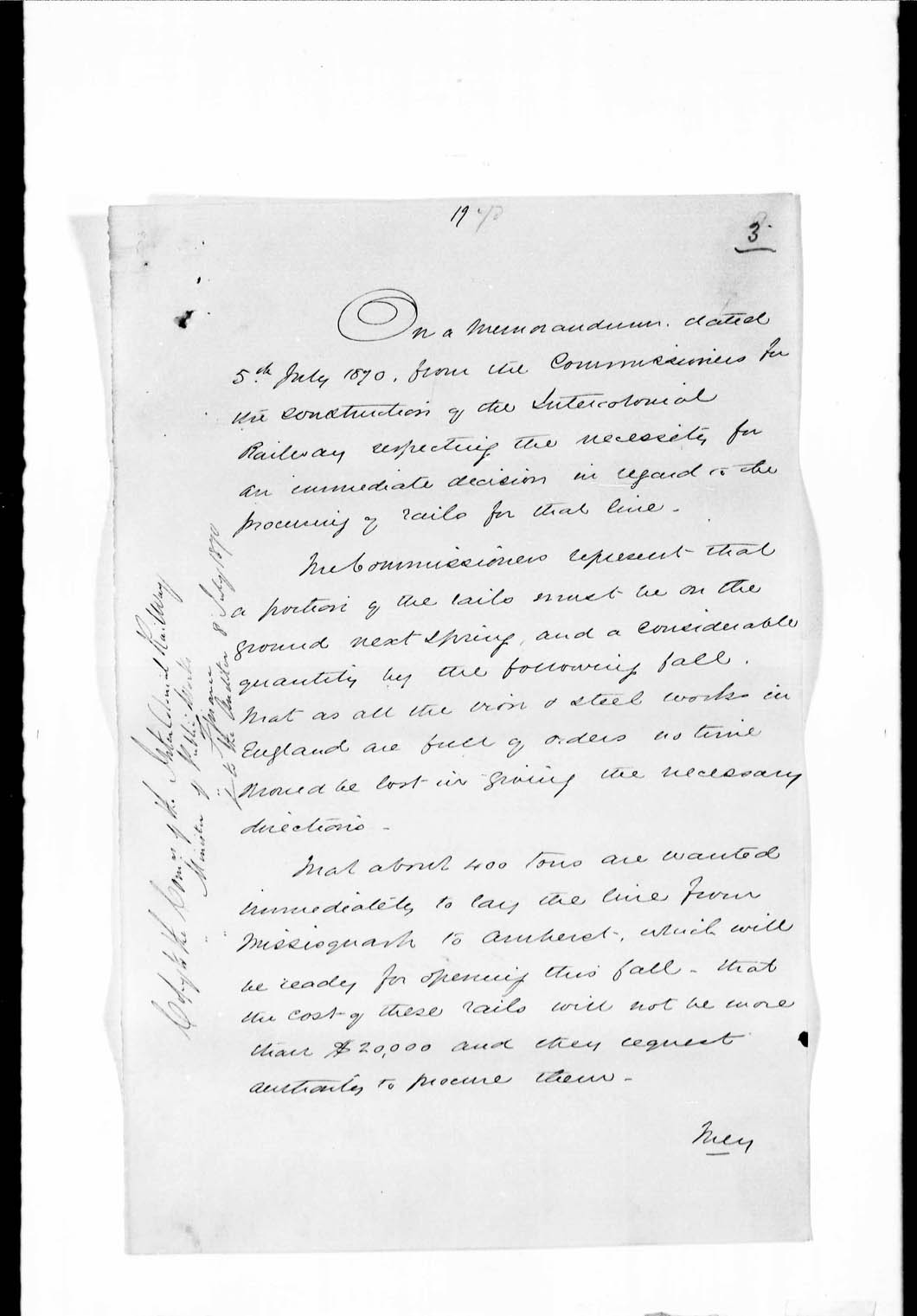
OIC 1870-0019, page 1
OIC 1870-0019, page 2
OIC 1870-0019, page 3
OIC 1870-0019, page 4
On a Memorandum dated 5th July 1870, from the Commissioners for the construction of the Intercolonial Railway respecting the necessity for an immediate decision in regards to the procuring of rails for that line. The Commissioners expect that a portion of the rails must be on the ground next spring and a considerable quantity by the following fall. That as all the iron & and steel works in England are full of orders, no time should be lost in giving the necessary orders. That about 400 tons are wanted immediately to lay the line from Missisquash* to Amherst, which will be ready for opening this fall. That the cost of these rails will not be more than $20,000 and they request authority to procure them. They also request an early decision respecting the rails for the whole line. The Commissioners on the recommendation of the Hon. Sir George Et. Cartier, acting for the Minister** of Public Works, advise that the Commissioners be authorized to procure the 400 tons immediately required on the most advantageous terms possible, leaving for the early consideration of the Council the question of providing rails for the whole line.
— Source:
Ottawa, Federal Government Orders in Council
http://www.collectionscanada.gc.ca/databases/orders/001022-100.01-e.php
* The Missisquash (or Missaguash) River is the modern boundary between Nova Scotia and New Brunswick. According to CN Employees' Timetables issued in the 1960s, the distance (measured along the track centerline) between the Missaguash River bridge and the Amherst Station is 3.47 miles (5.58km). If 400 tons of rails was needed for this length of track (and assuming that rails were sold by the short ton of 2000 pounds) we conclude that this main line track was constructed using rail that weighed 65 pounds per yard – commonly referred to as “sixty-five pound rail”. A railway constructed with sixty-five pound rail requires 115 tons of rail per mile of track.
115 tons per mile × 3.47 miles = 399 tons
** The Hon. Hector-Louis Langevin (1826-1906)
was the Acting Minister of Public Works
from 28 September 1869 to 7 December 1869.
He was Minister of Public Works
from 8 December 1869 to 5 November 1873.
Subject: Nova Scotia Railway — [Minister of Public] Works [recommends] dismissal of Edwd. Elmes, section foreman and Benjamin Goodwin, engine driver...
OIC 1871-1495, page 1
OIC 1871-1495, page 2
On a Memorandum dated 2nd November 1871, from the Hon. the Minister of Public Works representing that the Superintendent of the Nova Scotia Railway reports that from the accident which occurred on the 12th of September last the death of Edward Dimack(?) resulted – and damage also to the amount of $6955.00 and that he (the Superintendent) has therefore suspended Edward Elmes the foreman of that section of the line on which the accident occurred for want of vigilance and care – and has also suspended Benjamin Goodwin the Engine Driver for a breach of the regulations in allowing parties to ride on the Engine. The Minister therefore recommends that he be authorized to dismiss Edward Elmes and Benjamin Goodwin from further employment on the Government Railway. The Committee submit the same for your Excellency's approval.
— Source:
Ottawa, Federal Government Orders in Council
http://www.collectionscanada.gc.ca/databases/orders/001022-100.01-e.php
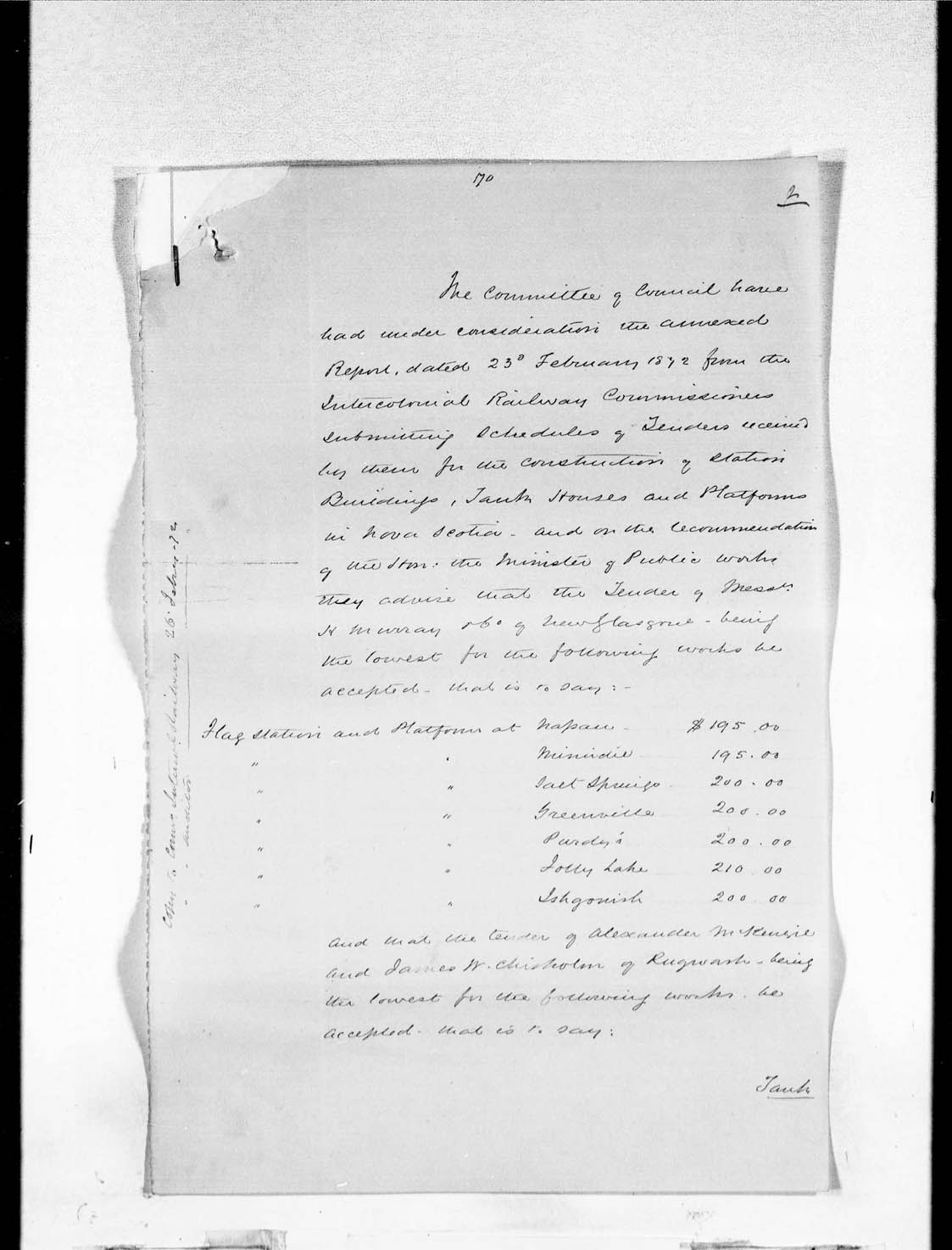
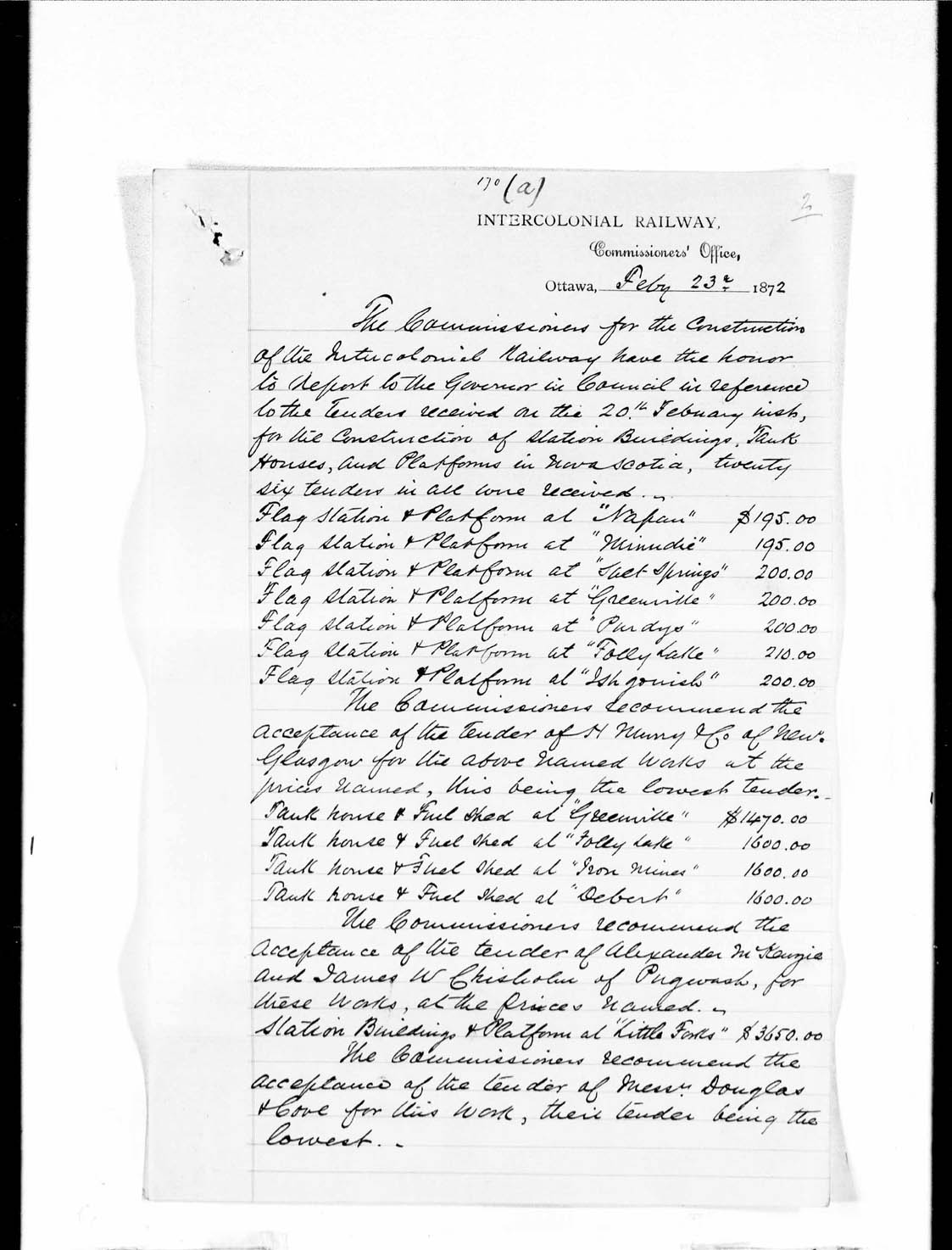
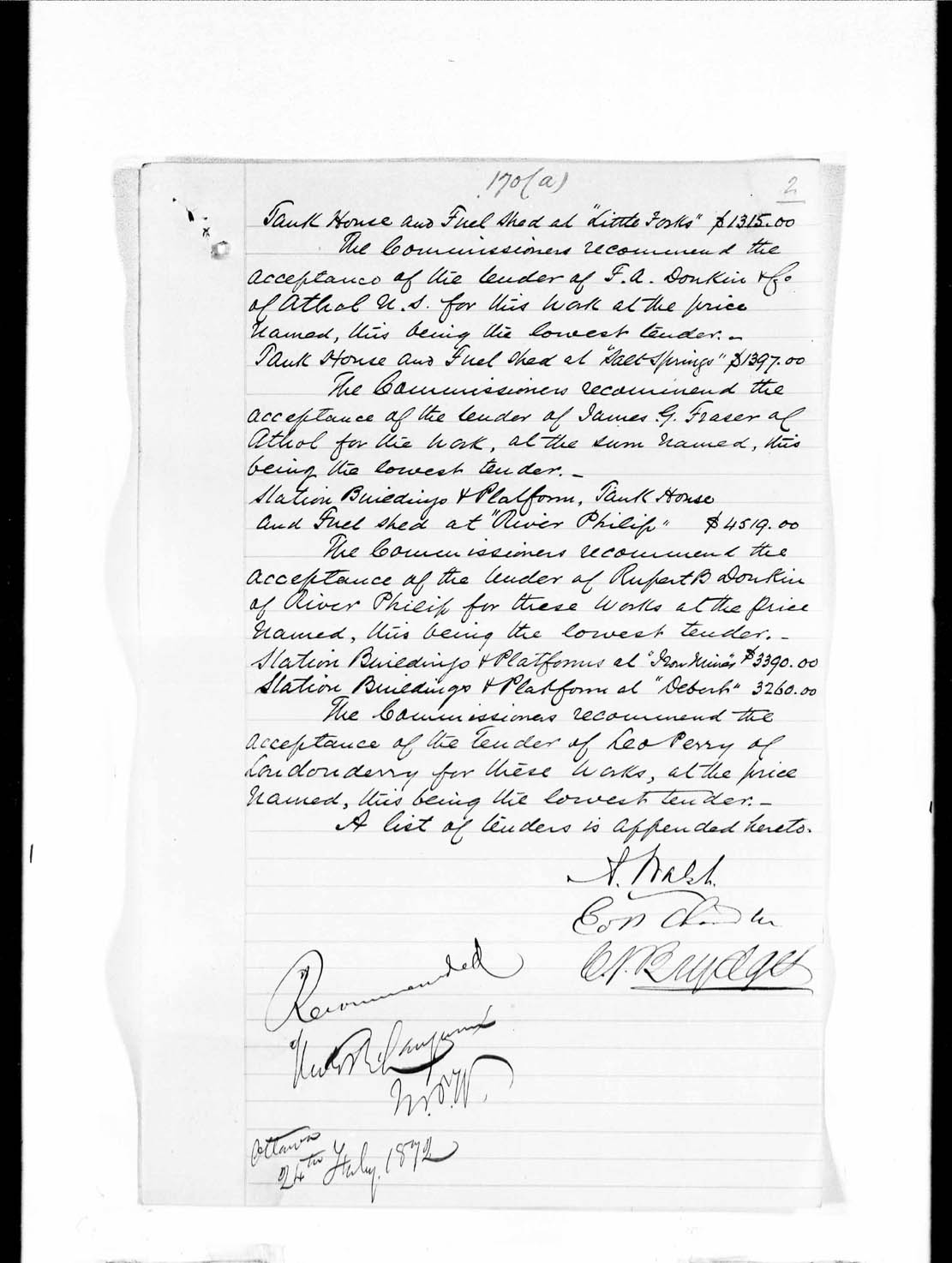
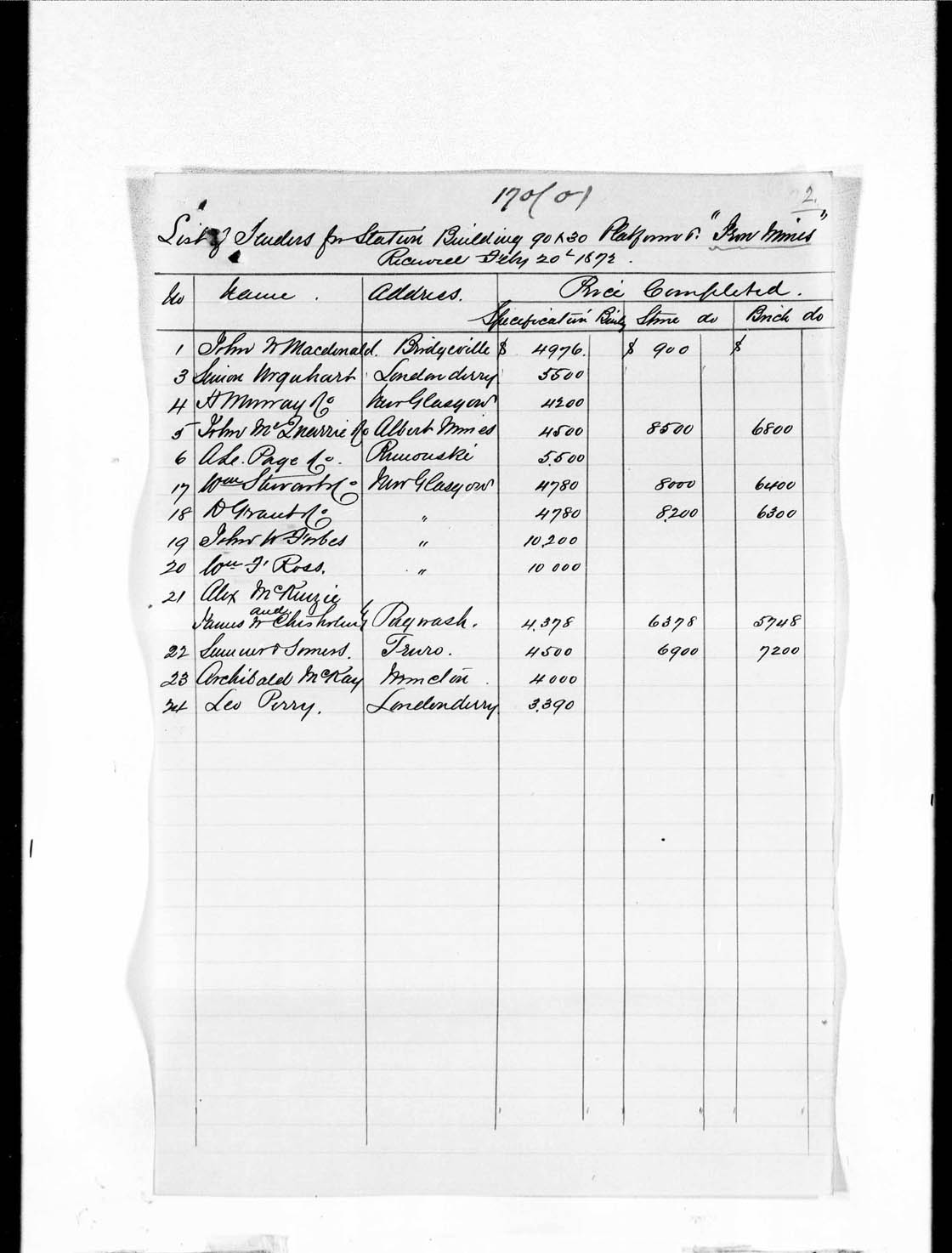
Subject: [Intercolonial Railway] — [Minister of Public] Works [recommended] accepting tenders for Station Buildings, Tank Houses and Platforms in [Nova Scotia] viz - Messrs H. Murray and [Company] New Glasgow, A.W. McKenzie and [James] W. Chisholm, Pugwash
Accepting tenders for Intercolonial Railway
Station Buildings, Tank Houses and Platforms in Nova Scotia:
OIC 1872-0170, page 1
OIC 1872-0170, page 2
OIC 1872-0170, page 3
Tenders accepted:
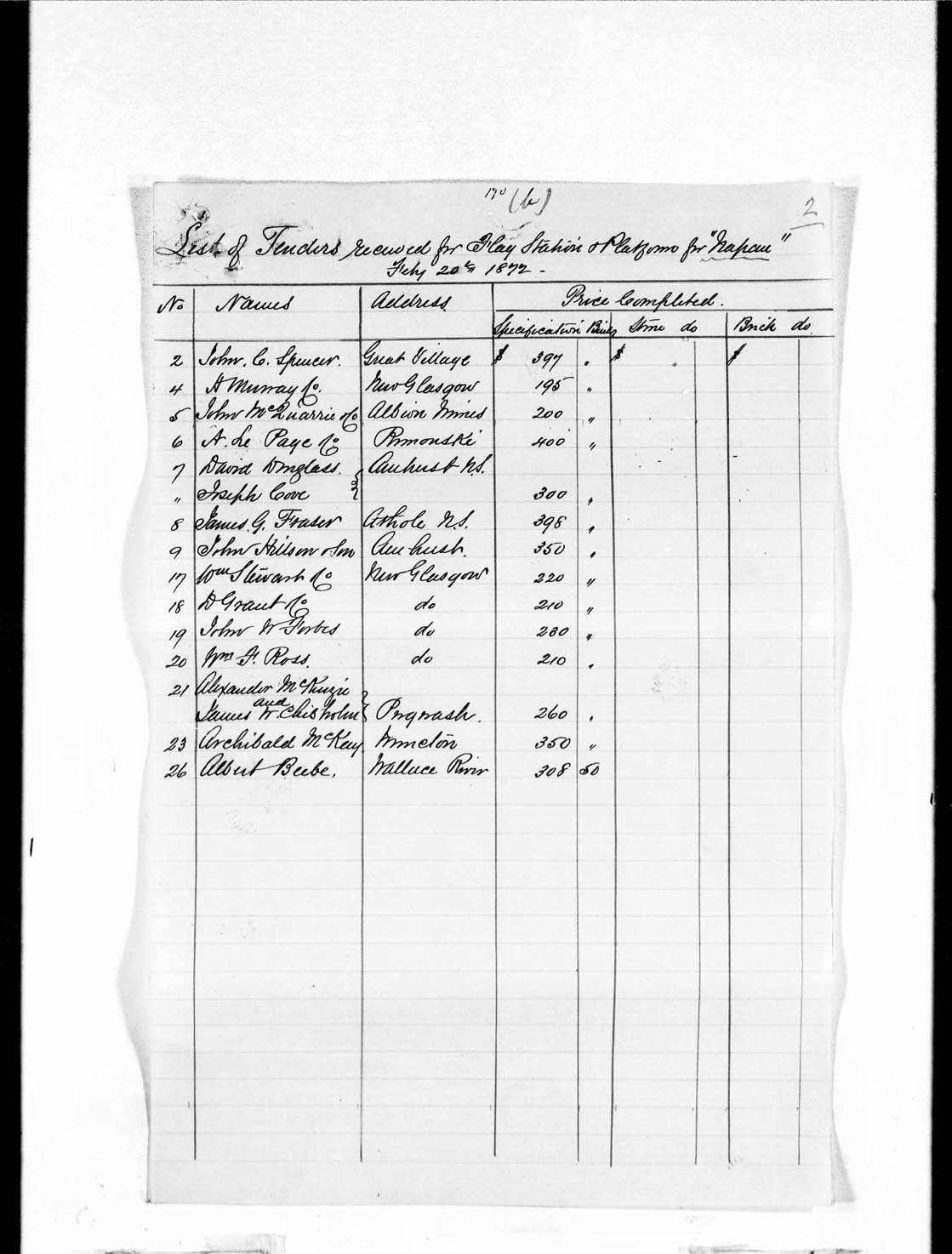
Flag Station and Platform at Napan $195.00
Flag Station and Platform at Minudie $195.00
Flag Station and Platform at Salt Springs $200.00
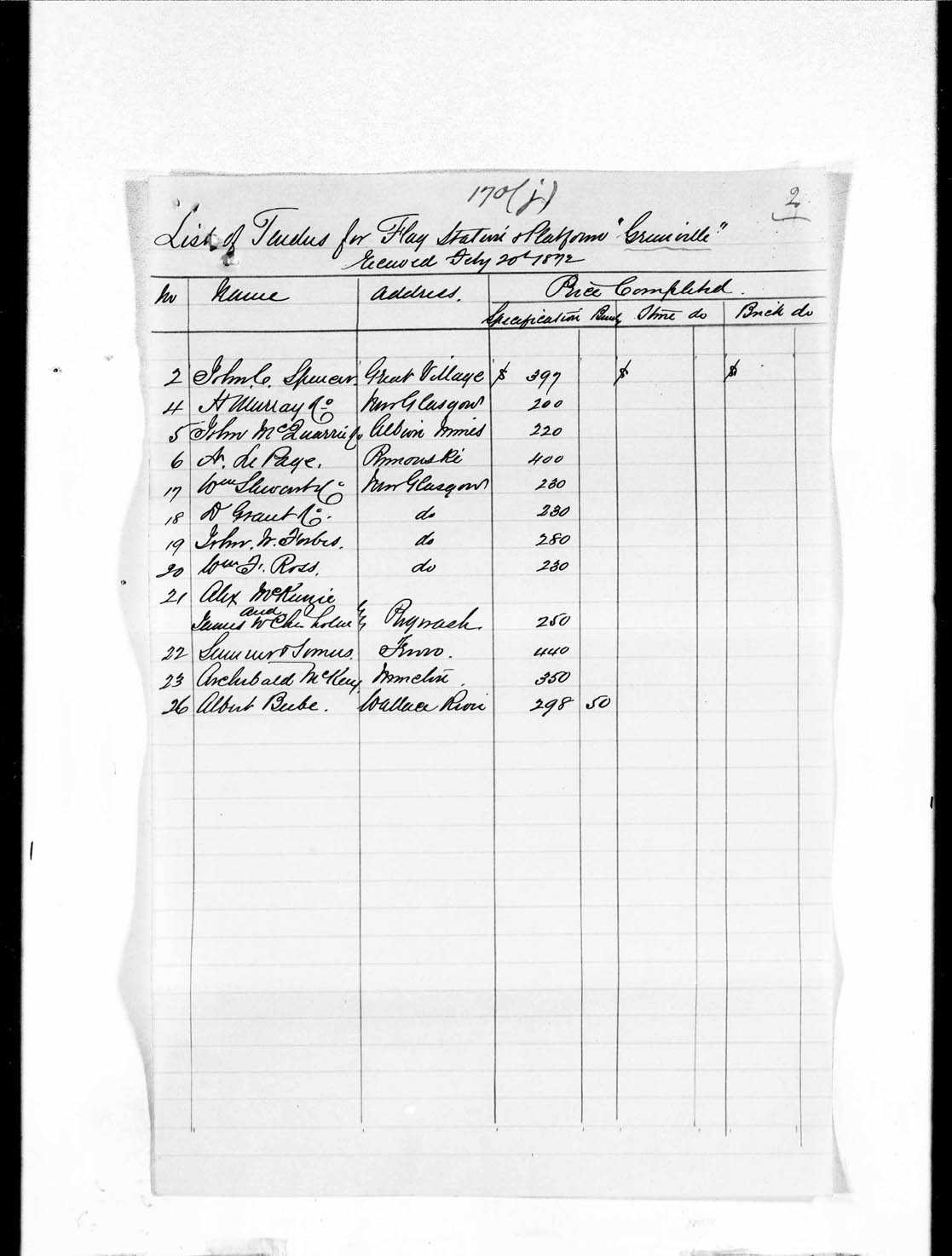
Flag Station and Platform at Greenville $200.00
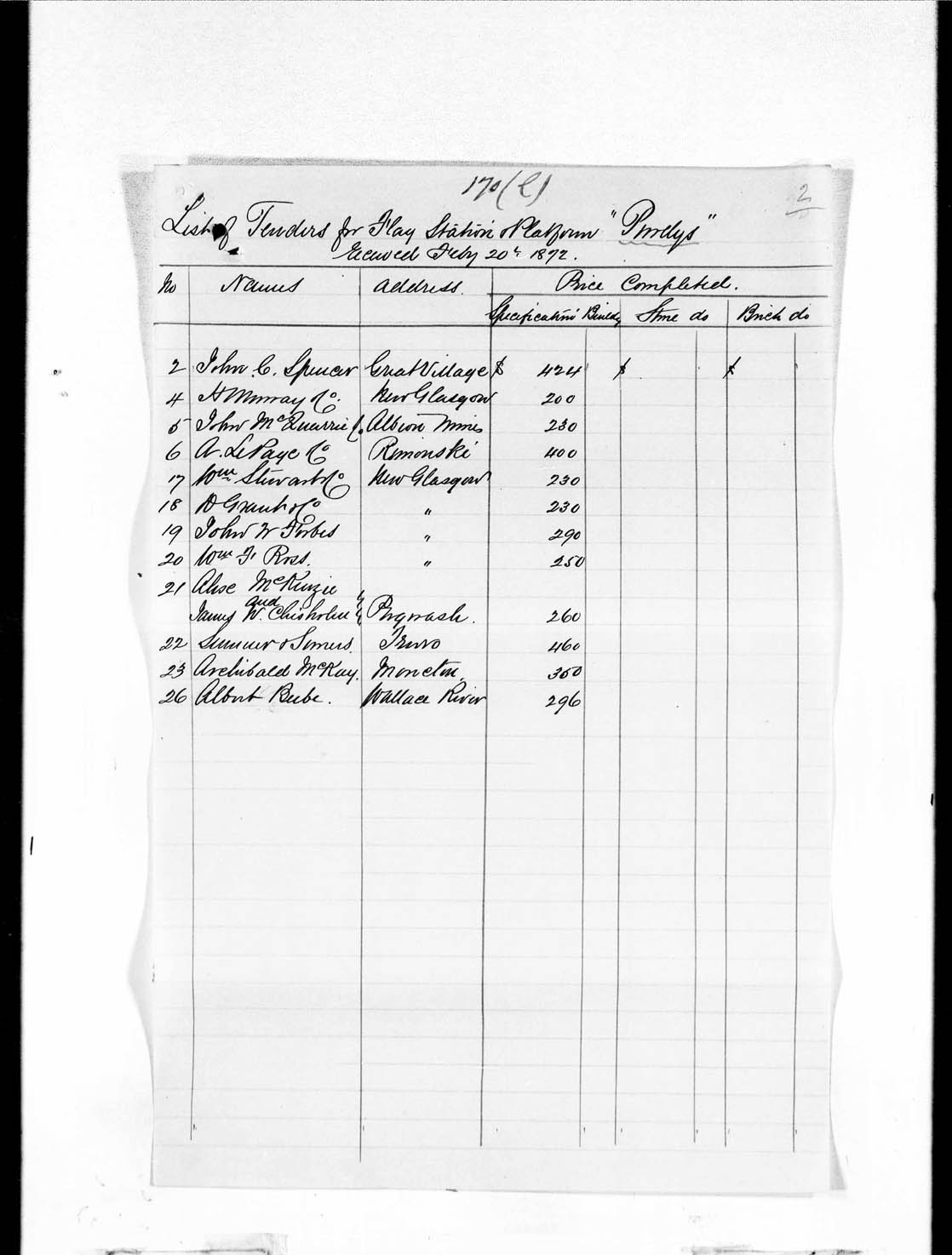
Flag Station and Platform at Purdy's $200.00
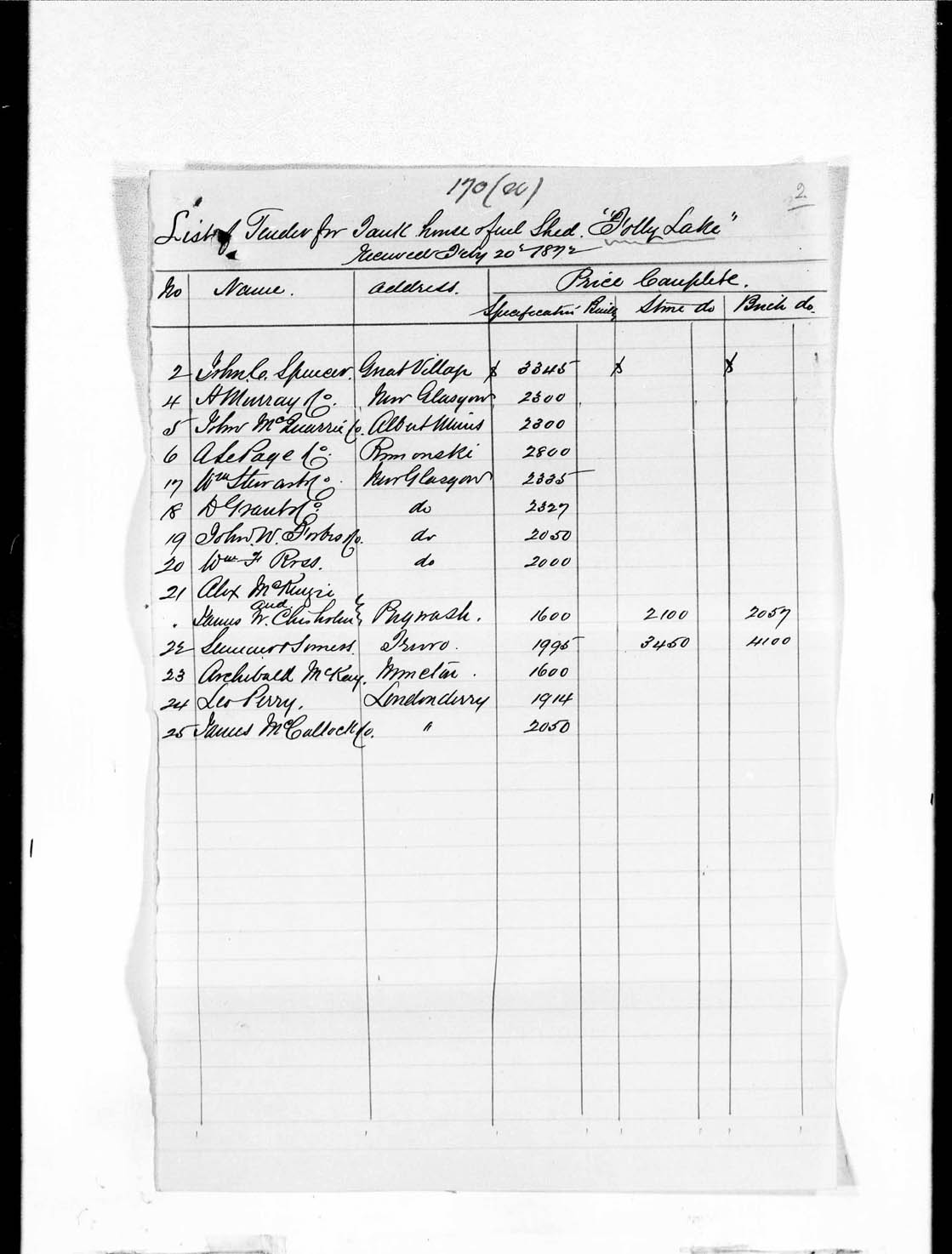
Flag Station and Platform at Folly Lake $200.00
Flag Station and Platform at Ishgonish $200.00
Tank House and Fuel Shed at Greenville $1470.00
Tank House and Fuel Shed at Tony Lake $1600.00
Tank House and Fuel Shed at Iron Mines $1600.00
Tank House and Fuel Shed at Debert $1600.00
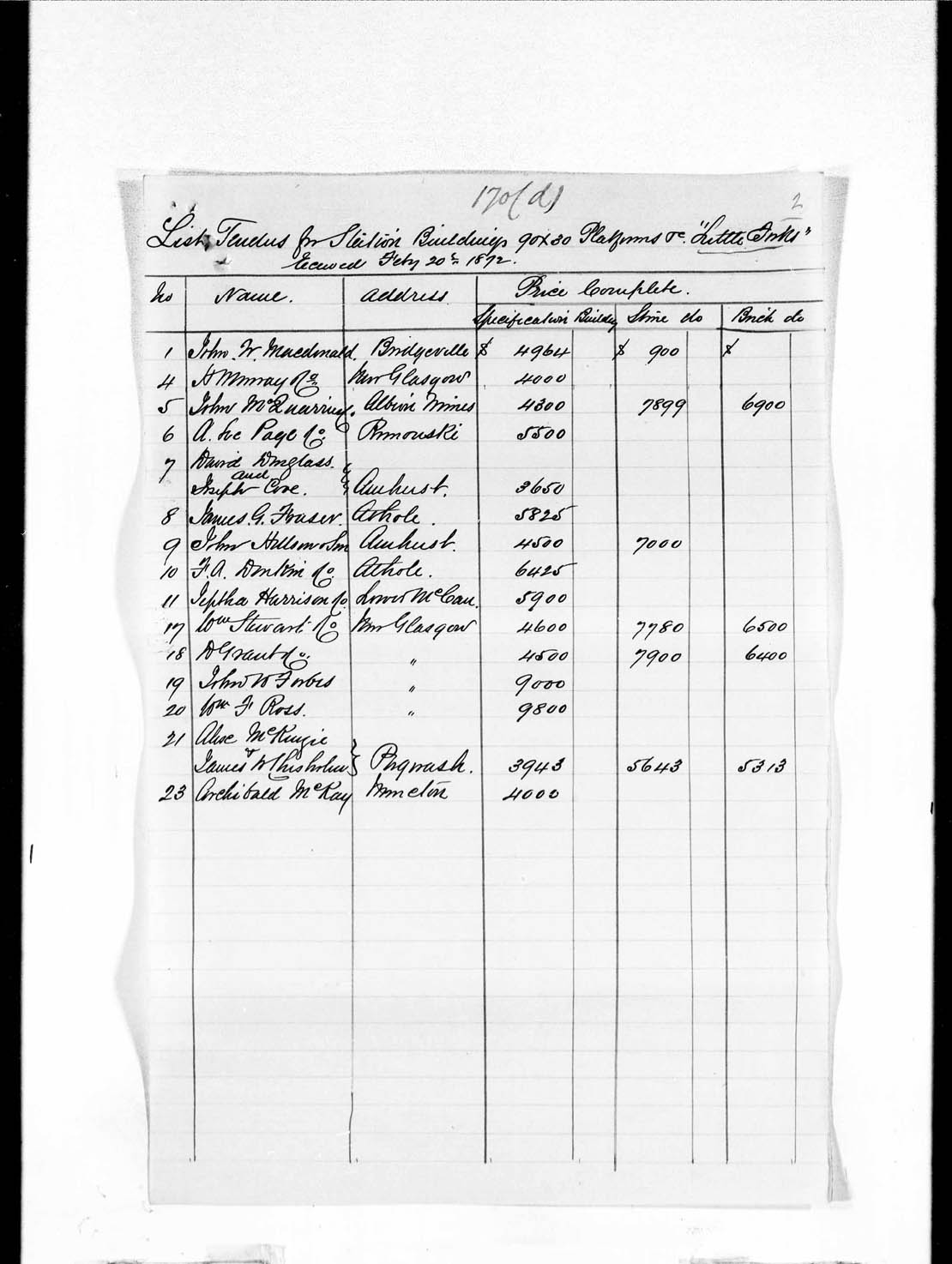
Station Building and Platform at Little Forks $3650.00
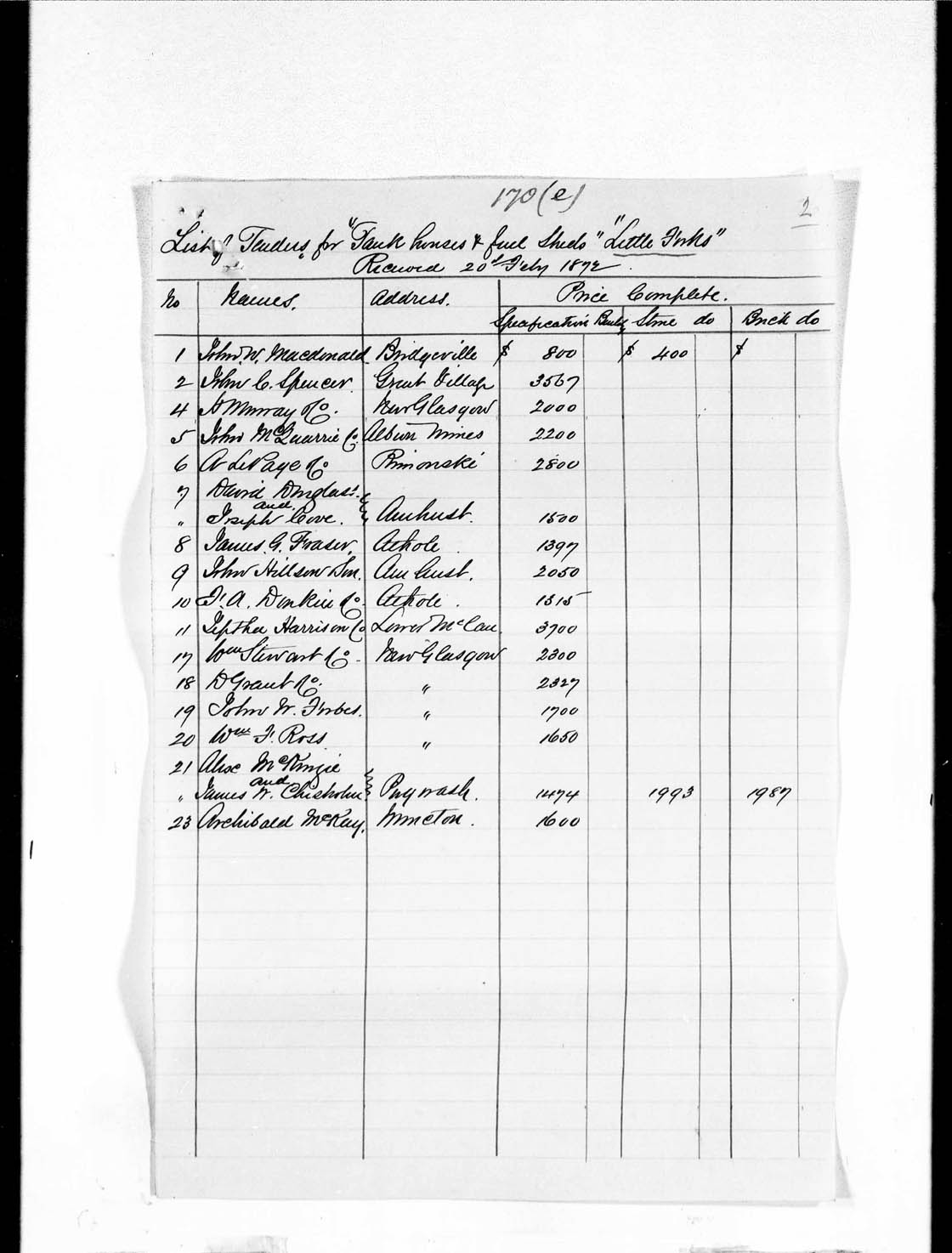
Tank House and Fuel Shed at Little Forks $1315.00
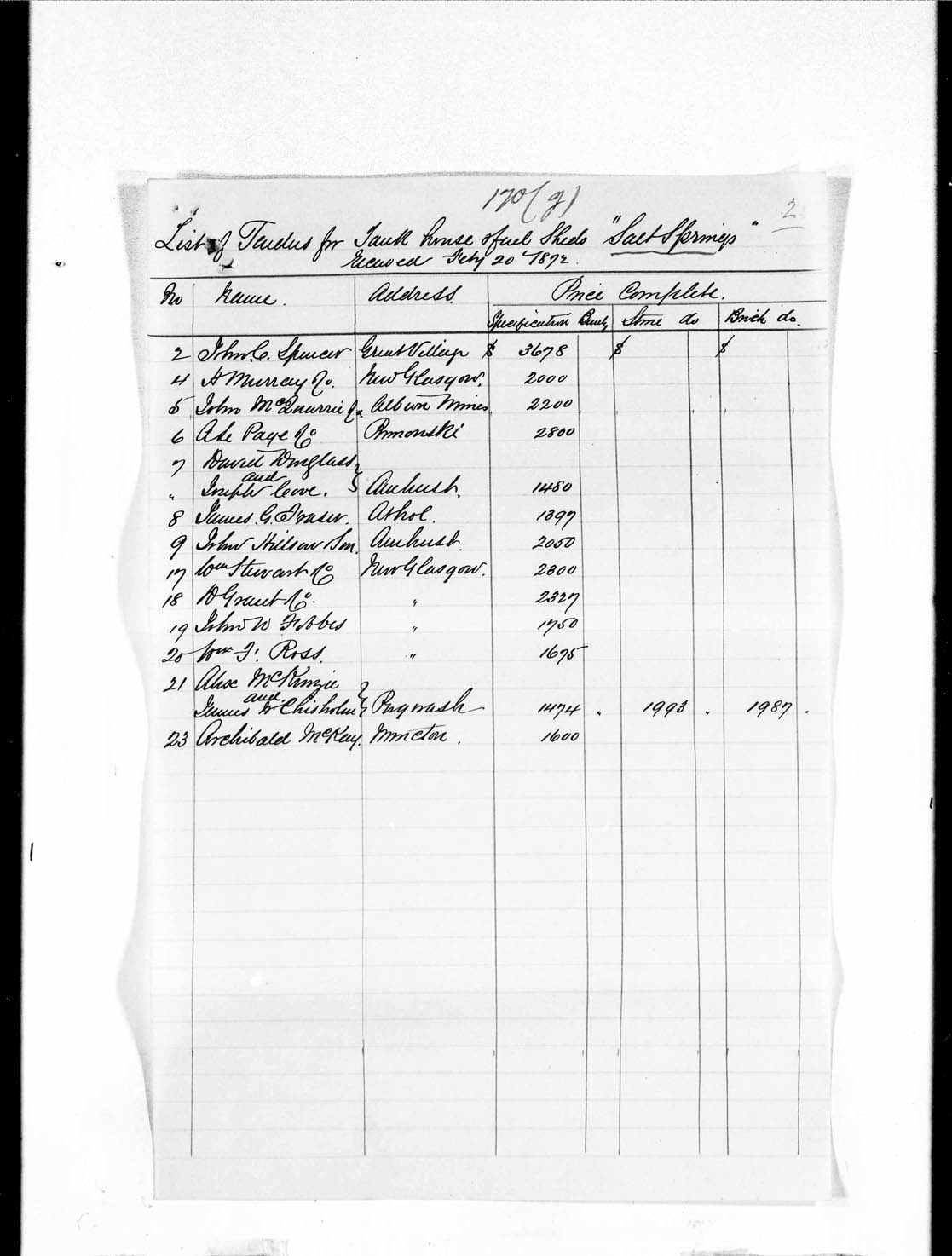
Tank House and Fuel Shed at Salt Springs $1397.00
Station and Platform, Tank House and Fuel Shed at River Philip $4519.00
Station Buildings and Platforms at Iron Mines $3390.00
Station Buildings and Platforms at Debert $3260.00
— Signed: Charles Tupper
OIC 1872-0170, page 4
OIC 1872-0170, page 5
OIC 1872-0170, page 6
(Tenders: Nappan, flag station and platform)
OIC 1872-0170, page 7
(Tenders: Minudie, flag station and platform)
OIC 1872-0170, page 8
(Tenders: Little Forks, station building 90×30 feet, and platform)
OIC 1872-0170, page 9
(Tenders: Little Forks, tank house and fuel shed)
OIC 1872-0170, page 10
(Tenders: Salt Springs, flag station and platform)
OIC 1872-0170, page 11
(Tenders: Salt Springs, tank house and fuel shed)
OIC 1872-0170, page 12
(Tenders: River Philip, station building 90×30 feet, and platforms)
OIC 1872-0170, page 13
(Tenders: River Philip, tank house and fuel shed)
OIC 1872-0170, page 14
(Tenders: Greenville, flag station and platform)
OIC 1872-0170, page 15
(Tenders: Greenville, tank house and fuel shed)
OIC 1872-0170, page 16
(Tenders: Purdy's, flag station and platform)
OIC 1872-0170, page 17
(Tenders: Folly Lake, flag station and platform)
OIC 1872-0170, page 18
(Tenders: Folly Lake, tank house and fuel shed)
OIC 1872-0170, page 19
(Tenders: Iron Mines, station building 90×30 feet, and platforms)
OIC 1872-0170, page 20
(Tenders: Iron Mines, tank house and fuel shed)
OIC 1872-0170, page 21
(Tenders: Debert, station building 90×30 feet, and platforms)
OIC 1872-0170, page 22
(Tenders: Ishgonish, flag station and platform)
OIC 1872-0170, page 23
(Tenders: Debert, tank house and fuel shed)
— Source:
Ottawa, Federal Government Orders in Council
http://www.collectionscanada.gc.ca/databases/orders/001022-100.01-e.php
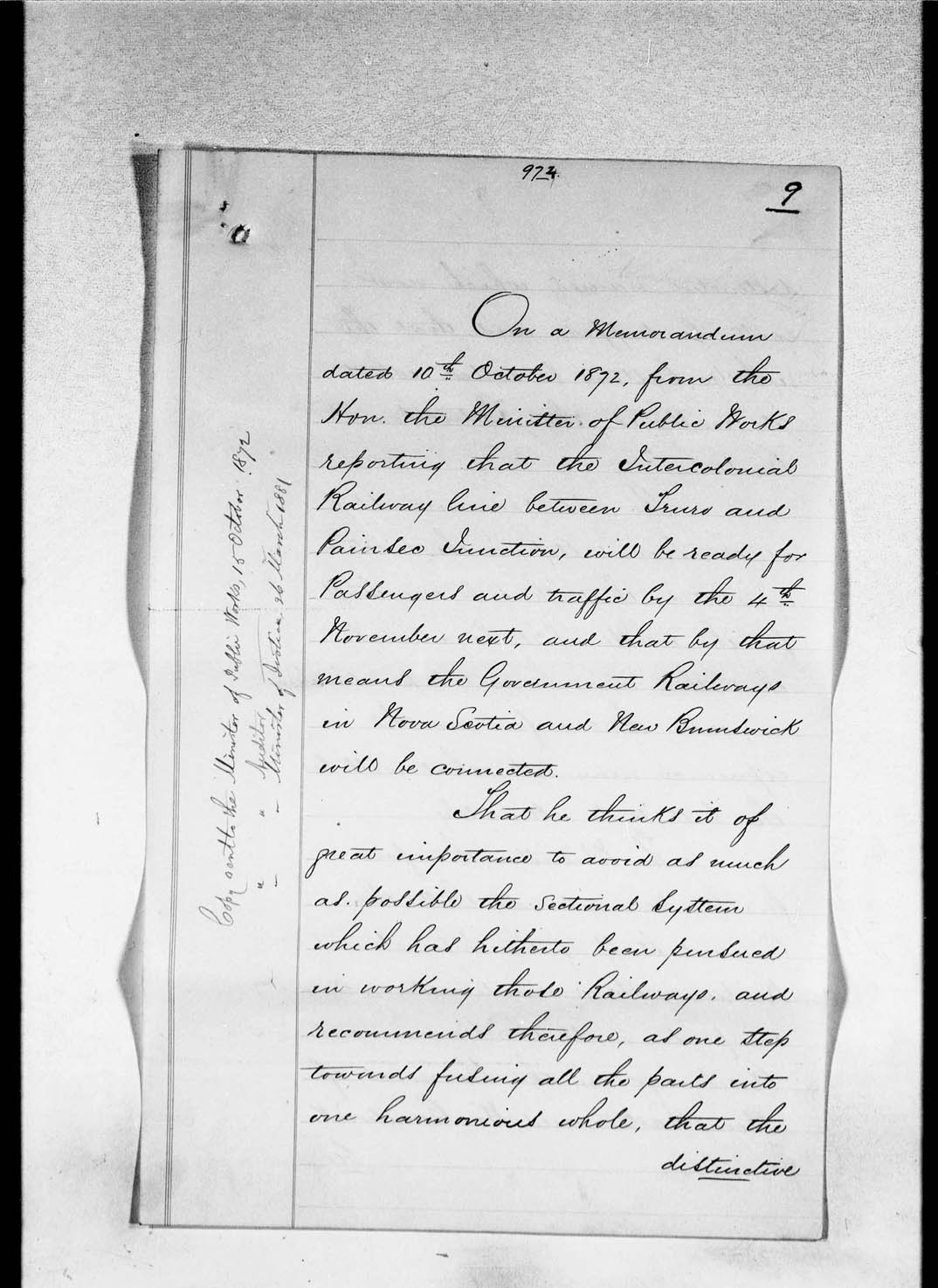
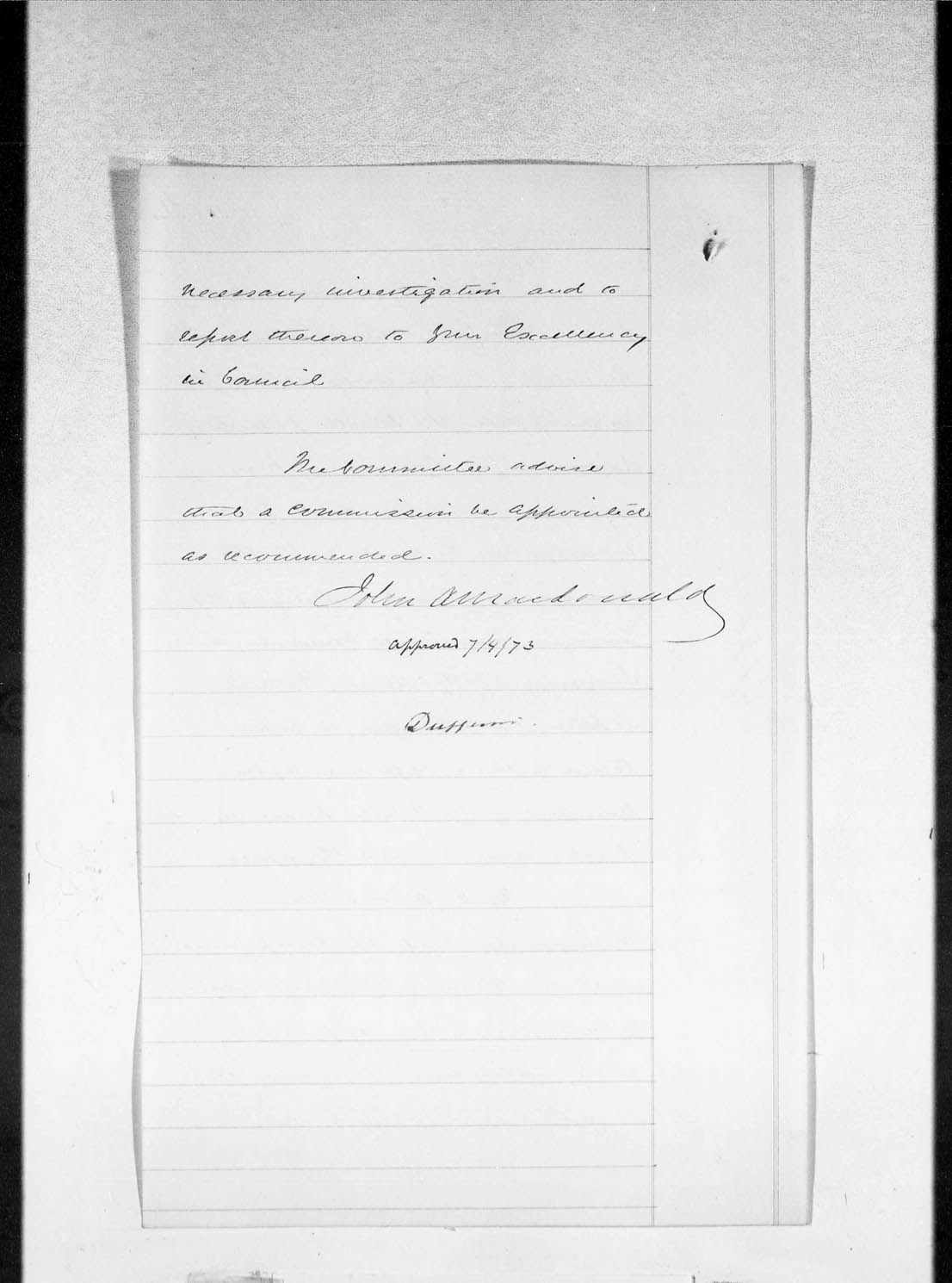
Subject: Intercolonial Railway — Minister of Public Works recommends all government railways in Nova Scotia and New Brunswick to be consolidated and designated the Intercolonial Railway - And also recommends reorganization of general staff necessary for working the railway as a single organization
OIC 1872-0974, page 1
OIC 1872-0974, page 2
OIC 1872-0974, page 3
OIC 1872-0974, page 4
On a Memorandum dated 10th October 1872, from the Hon. the Minister of Public Works reporting that the Intercolonial Railway line, between Truro and Painsec Junction, will be ready for Passengers and traffic by the 4th November next, and that by that means the Government Railways in Nova Scotia and New Brunswick will be connected... and recommends... as one step towards fusing all the parts into one harmonized whole, that the distinctive names (for the provincial railways), which now exist, be dropped, and that the whole System be called what it really is, the "Intercolonial Railway." He also recommends as the Second Step in the direction indicated, that there be one Staff for the whole... The Minister therefore further recommends that the General Staff of the Intercolonial Railway... comprising all the Government Railways in the Provinces of Nova Scotia and New Brunswick (be consolidated and) all these offices to reside at Moncton... The Committee submit the foregoing recommendations of the Minister of Public Works for Your Excellency's approval.
— Source:
Ottawa, Federal Government Orders in Council
http://www.collectionscanada.gc.ca/databases/orders/001022-100.01-e.php
Reference: Frederick Temple Blackwood, Marquess of Dufferin (1826-1902)
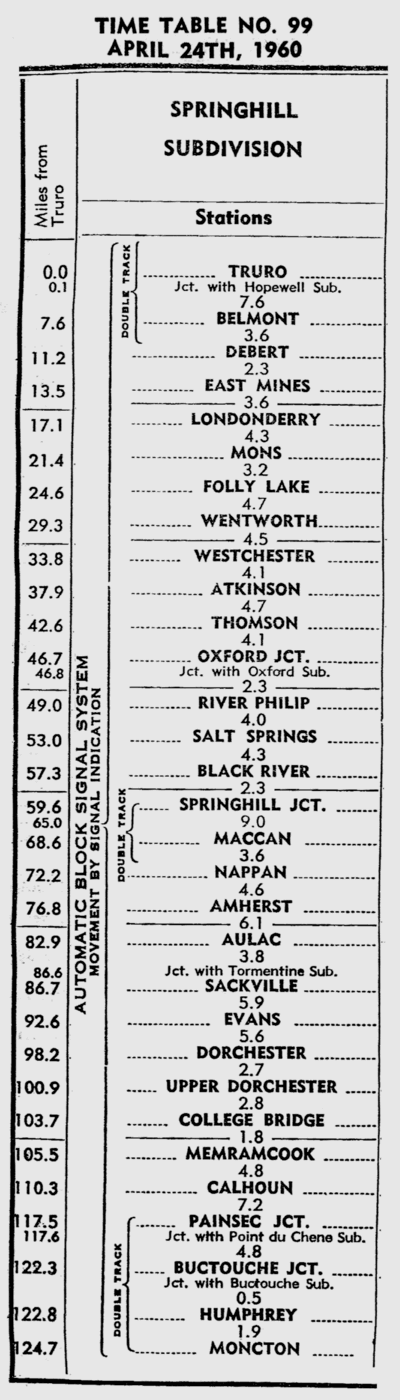
NOTE 1: The Missaguash River bridge (at the border between Nova Scotia and New Brunswick) would appear on this list between Amherst and Aulac, at mile 80.3.
NOTE 2: This new (1872) ICR track from Truro connected at Painsec Junction with the European and North American Railway's line from Saint John – the "Point du Chene Subdivision" – thus connecting Nova Scotia's railway system to that of New Brunswick. When this ICR rail line from Truro went into regular operation, early in November 1872, there was for the first time a continuous railway with daily passenger trains between Saint John and Moncton and other points in New Brunswick, and Truro, Halifax and Windsor and other points in Nova Scotia.
NOTE 3: “This 1960 track was the same as the 1872 track“ means that the right-of-way in 1960 (and in 2013) is the same right-of-way as has existed since the line was constructed in 1872 – obviously the track itself, the rails and ties and ballast, is not the original 1872 rails and ties and ballast.
References:
Intercolonial Railway Wikipedia
Nova Scotia Railway Wikipedia
European and North American Railway Wikipedia
E&NA “Eastern Extension” (Saint John to Shediac)
Canadian Government Railways Wikipedia
Windsor and Annapolis Railway Wikipedia
Subject: Intercolonial Railway and European and North American Railway, Nova Scotia and New Brunswick — Minister of Public Works recommended appointment of a Commission to enquire into arrangement and working of these Railways, in accordance with Address of Parliament
OIC 1873-0380, page 1
OIC 1873-0380, page 2
On a Memorandum dated 5 April 1873 from the Hon. the Minister of Public Works stating that on the 13 ulto. the Senate passed an Address to Your Excellency praying that an immediate and full investigation be made into the management and working of the European and North American, and Intercolonial Railways, between St. John and Halifax, in order to secure a more safe and regular transport of the mails, passengers and freight over the said Railways. That he the Minister recommends that in compliance with the terms of the said address a commissioner be appointed with instructions to make the necessary investigation and to report thereon to Your Excellency in Council. The Committee advise that a commissioner be appointed as recommended.
— Source:
Ottawa, Federal Government Orders in Council
http://www.collectionscanada.gc.ca/databases/orders/001022-100.01-e.php
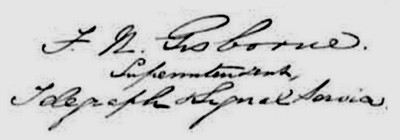
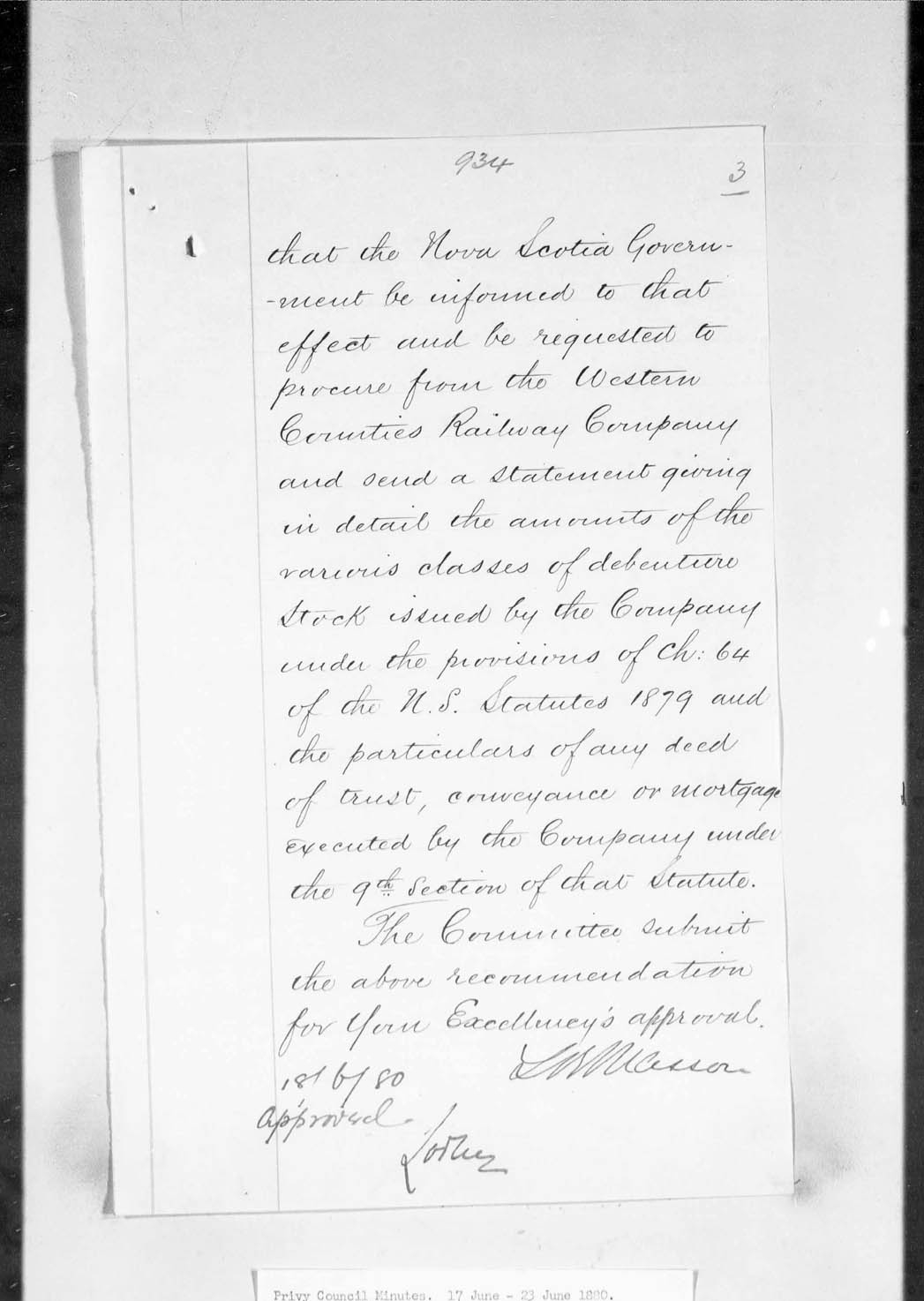
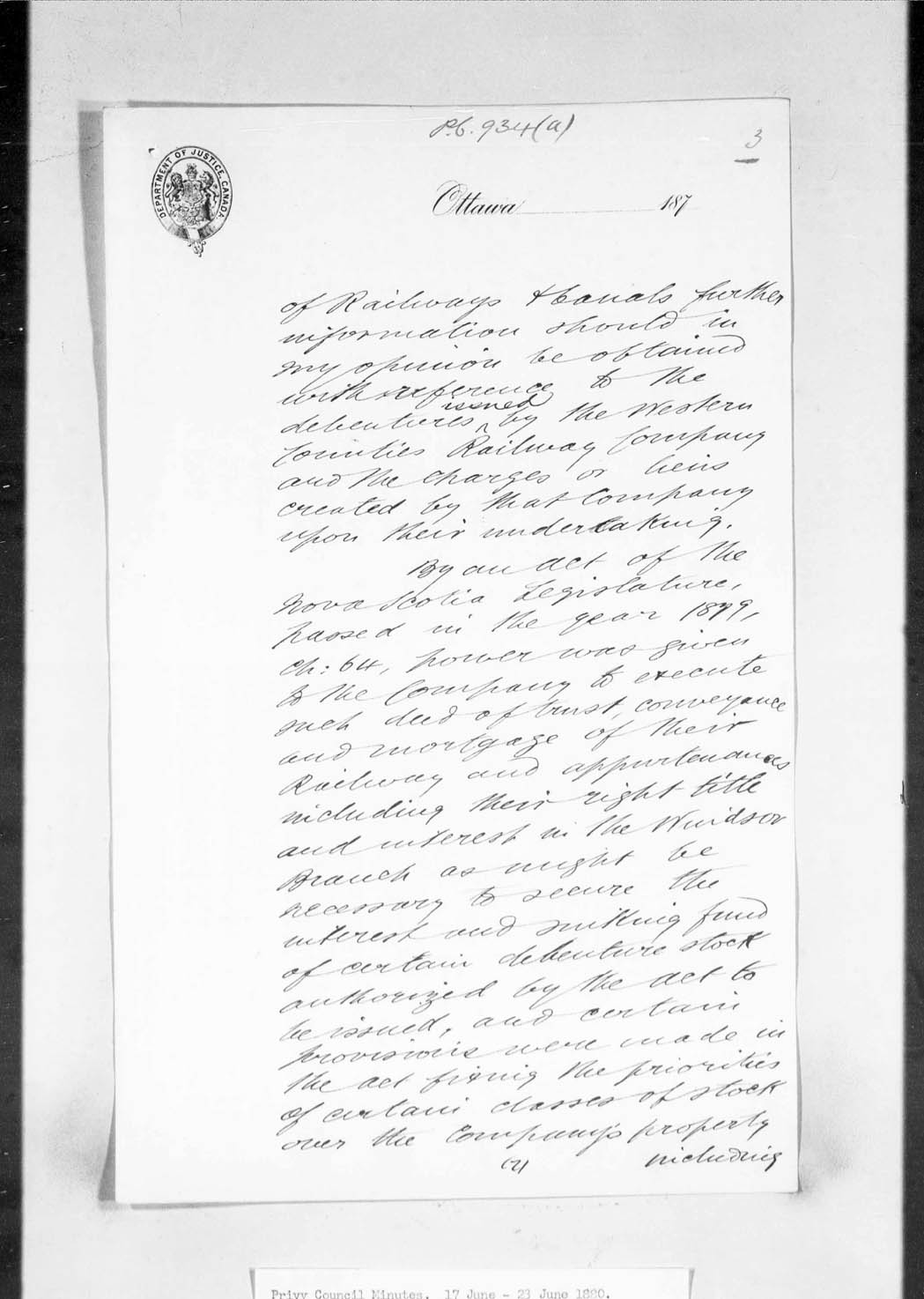
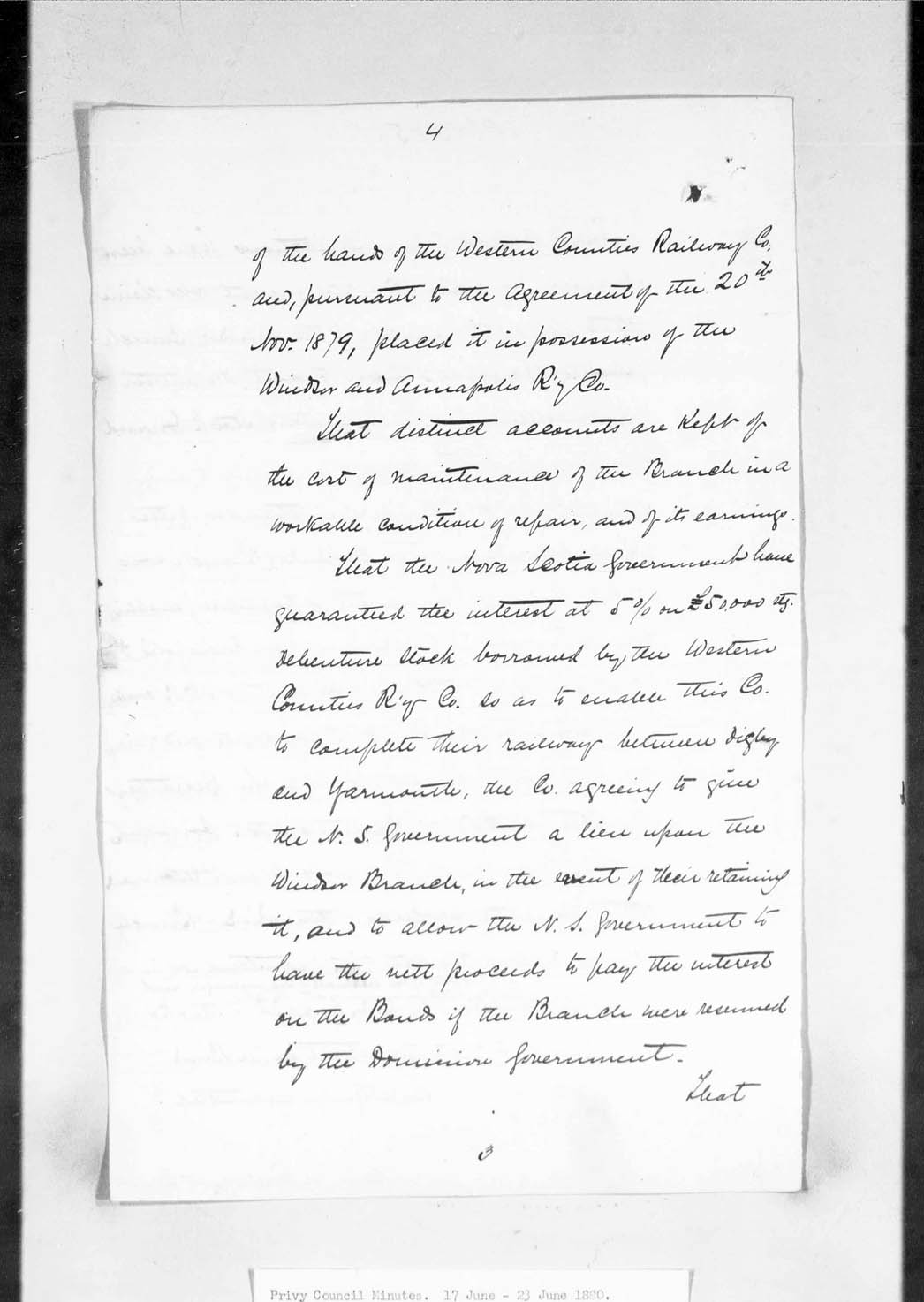
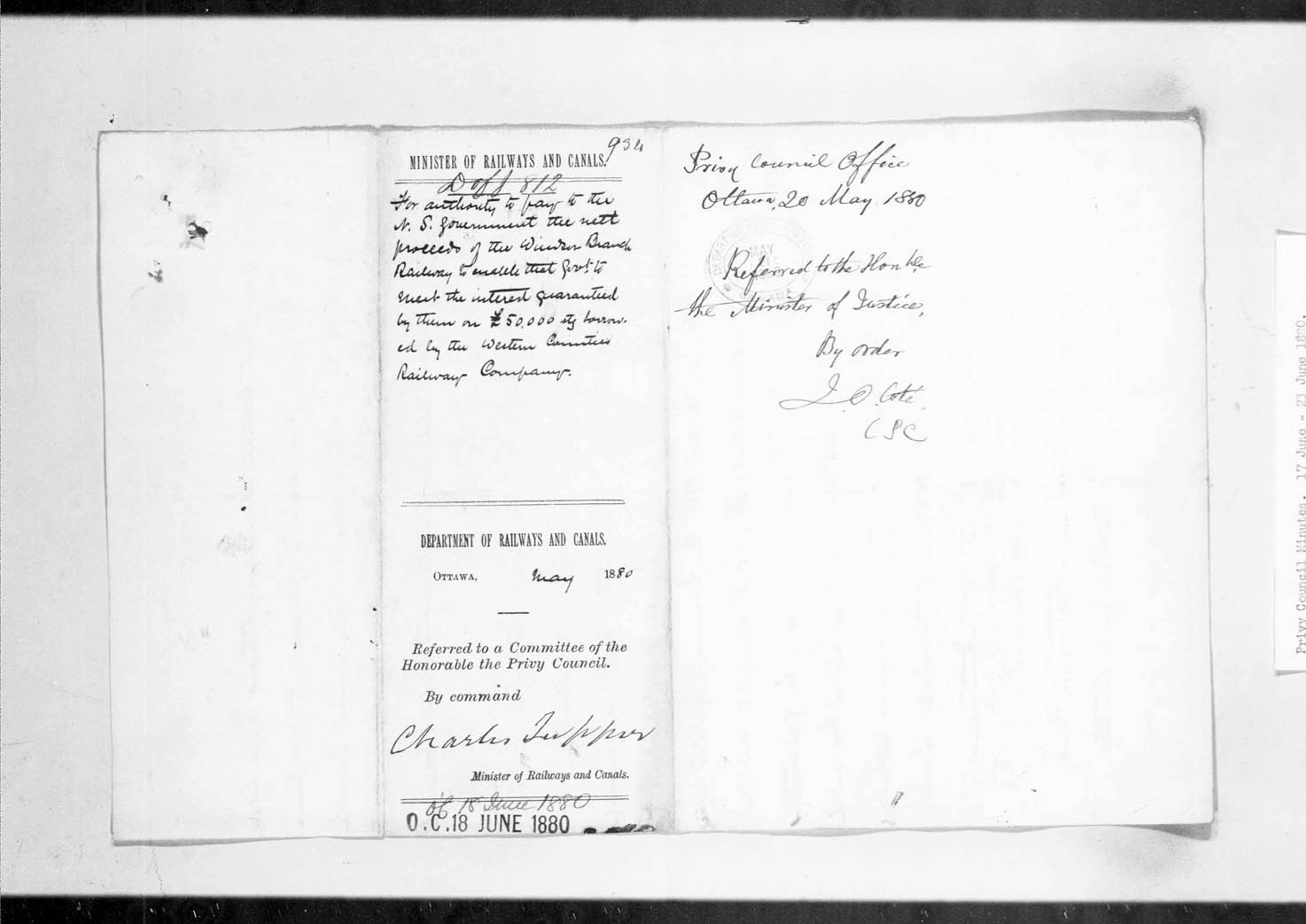
Subject: Intercolonial Railway, Windsor Branch — Minister of Railways and Canals recommends payment of proceeds to Government of Nova Scotia to meet interest on bonds of Western Counties Railway Company - Minister of Justice recommends Nova Scotia be paid the nett proceeds of the Windsor Branch over and above the cost of its maintenance...
OIC 1880-0934, page 1
OIC 1880-0934, page 2
OIC 1880-0934, page 3
OIC 1880-0934, page 4
OIC 1880-0934, page 5
OIC 1880-0934, page 6
OIC 1880-0934, page 7
(Page 7) ...Therefore recommended that the Nova Scotia Government be informed to that effect and be requested to procure from the Western Counties Railway Company and send a statement giving in detail the amounts of the various classes of debenture stock issued by the Company under the provisions of Ch: 64 of the N.S. Statutes 1879 and the particulars of any deed of trust, conveyance or mortgage executed by the Company under the 9th section of that Statute.
(signed) J. McDonald
Minister of Justice
OIC 1880-0934, page 8
OIC 1880-0934, page 9
OIC 1880-0934, page 10
OIC 1880-0934, page 11
OIC 1880-0934, page 12
OIC 1880-0934, page 13
(Page 13) ...Under the circumstances of the case, considering that the Windsor Branch was appropriated by Parliament for the purpose of enabling the extension of the Railway from Annapolis to Yarmouth, and that the Government of N.S. enabled the Western Counties Rly. Co. to complete and open the line from Yarmouth to Digby by guaranteeing the interest on £50,000 debenture stock borrowed by the Company, the undersigned recommends that the nett proceeds of the Windsor Branch over and above the cost of its maintenance in a workable condition of repair and of the cost of the renewal of the passenger and freight station building at Windsor be paid to the N.S. Government to meet the interest on the Bonds.
(signed) Charles Tupper
Minister of Railways & Canals
OIC 1880-0934, page 14
— Source:
Ottawa, Federal Government Orders in Council
http://www.collectionscanada.gc.ca/databases/orders/001022-100.01-e.php
Reference: James McDonald (1828-1912)
Reference: Sir Charles Tupper (1821-1915)
|
The Wayback Machine has archived copies
Archived: 2002 February 9
Archived: 2002 September 28
Archived: 2002 November 22
Archived: 2003 February 10
Archived: 2003 August 16
Archived: 2004 May 19
Archived: 2004 December 17
Archived: 2005 April 03
Archived: 2005 October 31
Archived: 2006 May 21
Archived: 2006 October 21
Archived: 2007 April 12
Archived: 2008 November 21
Archived: 2010 December 12
Archived: 2012 May 09
Archived: 2013 July 29
These links were accessed and found to be valid on 24 November 2013. |
  Hits per calendar month
       2015 Jun    112
       2015 May    153
       2015 Apr    147
       2015 Mar    147
       2015 Feb    156
       2015 Jan    136

       2014 Dec    159
       2014 Nov    199
       2014 Oct    215
       2014 Sep     93
       2014 Aug    105
       2014 Jul     75
       2014 Jun    154
       2014 May    130
       2014 Apr    158
       2014 Mar    184
       2014 Feb    164
       2014 Jan    182

       2013 Dec    197
       2013 Nov    221
       2013 Oct    188
       2013 Sep    133
       2013 Aug    111
       2013 Jul     99
       2013 Jun    160
       2013 May    192
       2013 Apr    262
       2013 Mar    289
       2013 Feb    520
       2013 Jan    493

       2012 Dec    184
       2012 Nov    247
       2012 Oct    244
       2012 Sep    132
       2012 Aug    133
       2012 Jul    109
       2012 Jun    108
       2012 May    188
       2012 Apr    229
       2012 Mar    195
       2012 Feb    164
       2012 Jan    183

       2011 Dec    159
       2011 Nov    198
       2011 Oct    165
       2011 Sep     91
       2011 Aug     94
       2011 Jul     78
       2011 Jun    110
       2011 May    119
       2011 Apr    109
 |

W3C CSS Validation Service |