
Plaque date: 1952
Photographed on 31 October 2003
Located on the north side of the highway,
opposite the Port Royal Habitation National Historic Site
GPS location: 44°42'49"N 65°36'35"W
Google map
William Alexander, Earl of Stirling (c.1577-1640)
[Not to be confused with Sir William Alexander (c.1602-1638)]
Alexander persuaded King James VII/II that the only way to get Scots to emigrate
was to give them a new Scotland comparable to New France and New England;
and the king conveyed the royal wish to the Council of New England and obtained
from the latter the surrender of all their territory north of the Sainte-Croix.
Thereupon the king immediately instructed the Scottish Privy Council to prepare
a grant of this territory for Sir William Alexander. The grant was signed on
10 September 1621 (o.s.), making Sir William, on paper at least, lord proprietor of
the region now known as the three Atlantic Provinces and the Gaspé peninsula
– to be called for all time New Scotland or Nova Scotia.
Sir William Alexander (c.1602-1638)
[Not to be confused with William Alexander, Earl of Stirling (c.1577-1640)]
On 4 February 1628/29 Alexander, the Kirkes, and others obtained a
monopoly of the trade to Canada. While the Kirkes went off to capture
Quebec, Alexander joined forces with Sir James Stewart, Lord Ochiltree,
helped him build a fort at Port de la Baleine (now Baleine) in Cape Breton,
and then, under the guidance of Claude de Saint-Étienne de La Tour,
proceeded to Port-Royal. Here, in the summer of 1629, Alexander built
a new fort in which he decided to pass the winter, sending back his ship for
additional supplies and colonists. He also dispatched Claude de La Tour
with an agreement for his father, Sir William, to sign, the terms of which
conferred the title of knight-baronet and a large grant of land on Claude
and his son Charles de Saint-Étienne de La Tour, in return for their
assistance and allegiance. This agreement, slightly modified,
was duly signed by Alexander's father 30 April 1630.

Thanks to Mrs. Hannelore Fisher.
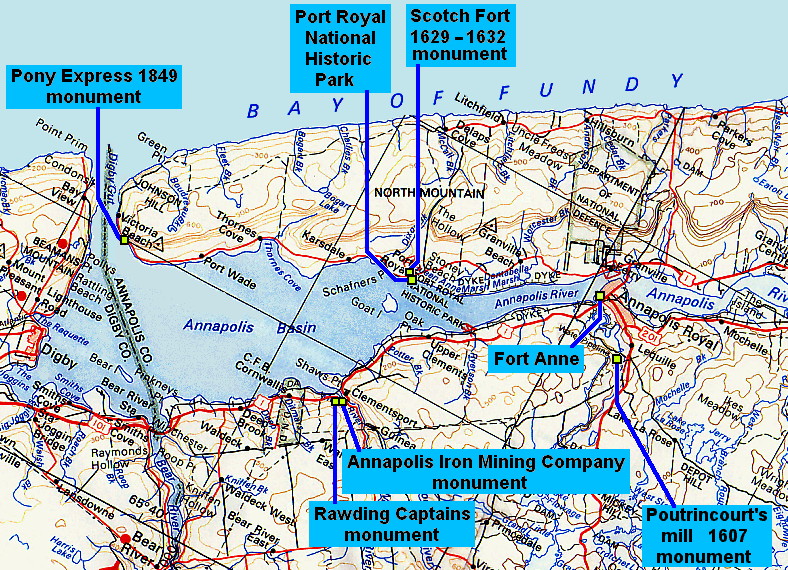
Roads are shown as they were in 1978. Except for Highway 101, the
layout of the roads in 2006 has not changed much from that shown here.
Links to Relevant Websites
Father and Son on Different Sides of Conflict, for a While,
On the Trail of the Scots of Annapolis County
Saint-Germain-en-Laye treaty 1632 Wikipedia
Saint-Germain-en-Laye treaty, signed on 29 March 1632
Remembering Our Acadian Heritage by Jim Bradshaw
History of Acadia Quebec History Encyclopedia
Chapter II: The British in Acadia Quebec History Encyclopedia
Cardinal Richelieu, Prime Minister of France 1624-1642
|
 Sir William Alexander monument Victoria Park, Halifax
 Port Royal Habitation 1605-1613 Port Royal
 Poutrincourt's 1607 Mill monument LeQuille
 Bloody Creek 1757 monument Bloody Creek
 Fort Anne bronze cannon Annapolis Royal
 1849 Nova Scotia Pony Express Monument Victoria Beach
 Rawding Captains monument Clementsport
 Annapolis Iron Mining Company monument Clementsport
 Fort Point monument LaHave
 Clementsport war memorial
 Edward Phinley Morse plaques Clementsport
 Clementsvale war memorial Clementsvale
 Bear River war memorial Bear River
 Smiths Cove war memorial Smiths Cove
 Bridgetown war memorial Bridgetown
 Arthur Kennedy tombstone LeQuille
First uploaded to the WWW: 2004 March 20
Added Google Map link: 2008 March 28
Latest update: 2013 October 15