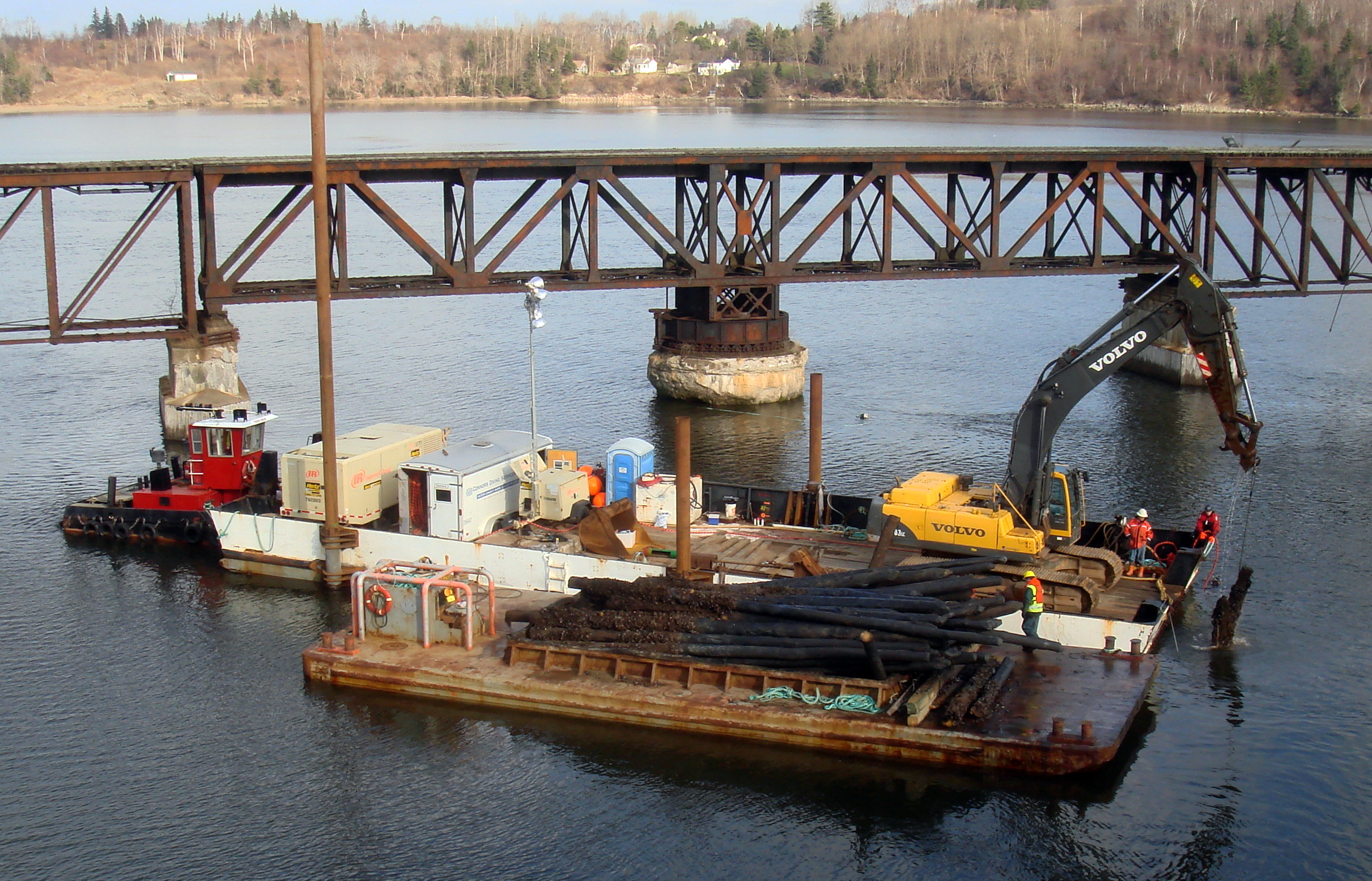
Dominion Atlantic Railway Bear River Bridge 13 December 2011 12:08pm
These wood piles had been driven into the bottom decades ago, and had
remained in place undisturbed ever since. They did not come up easily.
The backhoe operator had to work the boom from side to side while maintaining
a steady strong upward pull close to the limit of the machine's capacity – forcing
the barge much deeper in the water. After several side-to-side cycles of this
intense working, these old piles finally were loosened so they could pulled up.
The barge's spud legs demonstrated their usefulness during this work. In this
photograph, two of them are seen to be deployed – extended downward into the
sea bottom. When the spud legs are positioned in this way, the barge is free
to move vertically (as the tide rises or falls, or as the load imposed on the barge
varies as the backhoe operator reels in the sling, trying to pull these piles up)
but is constrained from horizontal movement (as tidal currents and wind
affect the barge, or as the backhoe operator works the boom from
side to side while pulling on recalcitrant piles).

