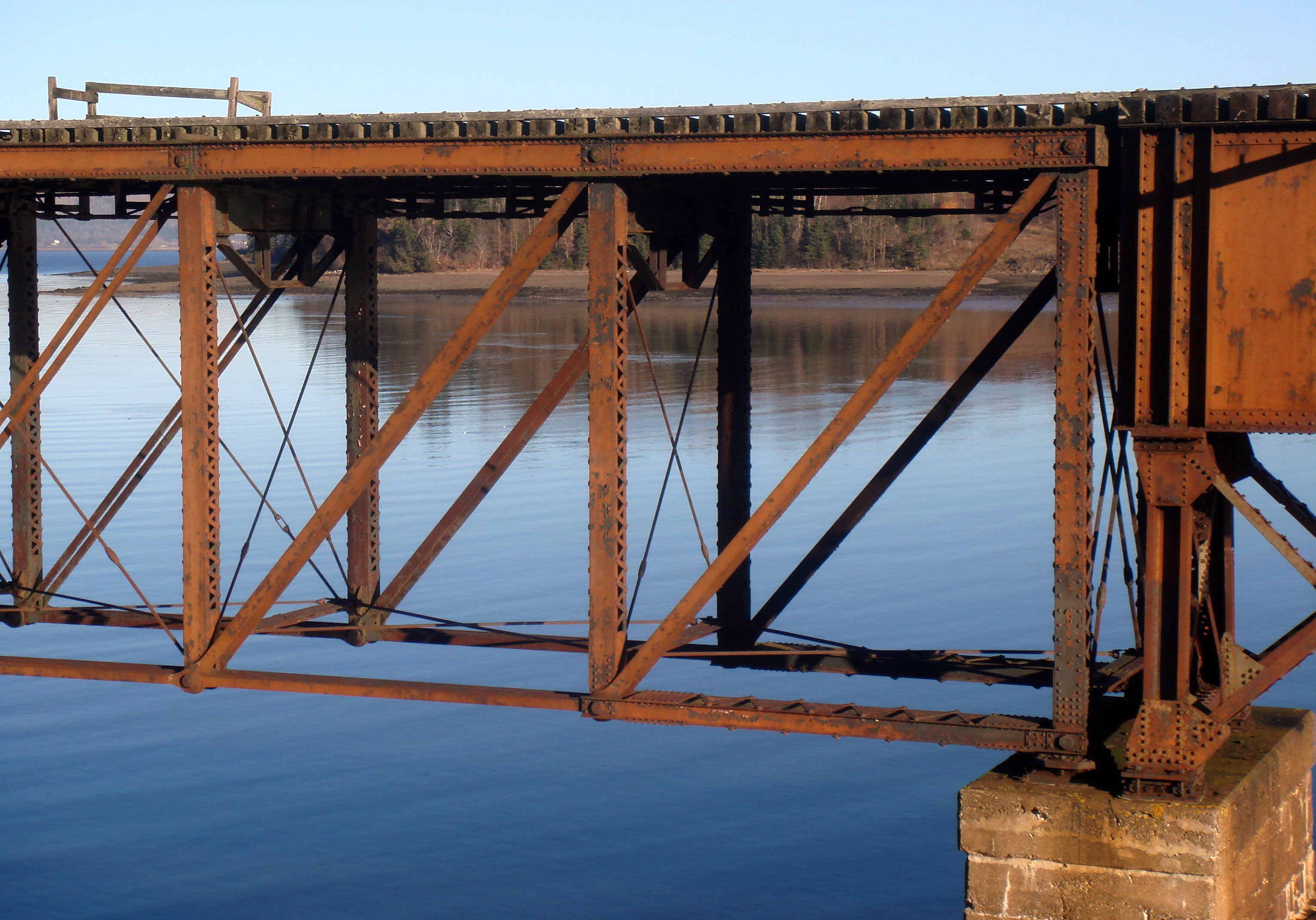
Dominion Atlantic Railway Bear River Bridge 12 November 2010
In November 2010 the bridge structure was still complete.
It appears here the same as it had for the last hundred years
(only the rails and the telegraph wires are missing).
Dominion Atlantic Railway Bear River Bridge 12 November 2010
In November 2010 the bridge structure was still complete.
It appears here the same as it had for the last hundred years
(only the rails and the telegraph wires are missing).
Q. Why do high school math classes spend so much time on triangles? Who cares about triangles?
A. In the design of structures, such as buildings and bridges, the lowly triangle
is the most basic – and the most important – of all geometric shapes.
Often these ubiquitous triangles are hidden from view, and as a result we are unaware
of their existence. However, in some structures these triangles are in plain sight
but even then many of us are unaware of their existence – we just don't see them.
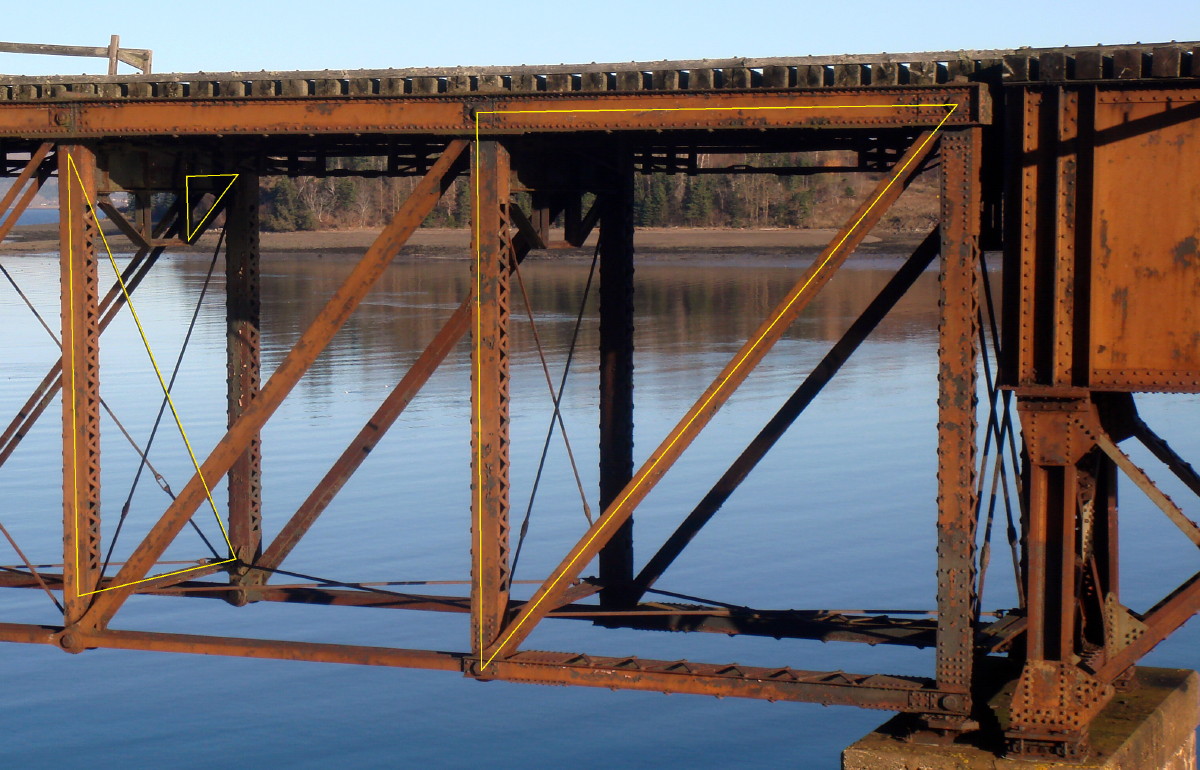
This bridge is a good example. There are hundreds of triangles in plain sight.
Here are three photographs of this bridge, with a few of the triangles outlined in yellow.
Why are these triangles important? Before these bridge trusses were manufactured,
somone had to design them. What does "design" mean? What information did
the bridge manufacturing department need, to be able to make each truss?
The manufacturing people had to know exactly what component parts
were needed. Each individual piece, how long? How thick? Thickness is
important. If a part is made too thick, it will cost too much for material.
If it is too thin it may fail and the bridge will collapse.
"Design" means that before anyone started working to make any of these
bridge trusses, someone did a mathematical analysis of each truss. This
mathematical analysis told the designer exactly how much stress (force) that
each strut had to be able to withstand when a heavy train ran across this bridge.
Once the designer knew how much stress each part had to be able to withstand,
he/she could decide just how much material was needed to make that particular part.
This information was delivered to the manufacturing department, which then was
able to make each part. That this design was done properly is demonstrated
by the fact that this bridge did not collapse, but successfully carried heavy
trains daily for 77 years, 1913-1990. Look carefully at these photographs.
They clearly show that some parts are thick, while others are quite slender.
Someone had to decide exactly how big each individual part had to be,
while at the same time not using any more material than was really needed.
One of the most serious stress conditions for a high bridge like this – one that
certainly was taken into consideration by the designer of this bridge – is when a
long heavy train is running across the bridge during an intense storm with a strong
wind blowing sideways (perpendicular to the length of the bridge). This condition
has been in the mind of every bridge designer since 28 December 1879.
The successful design of this bridge across Bear River was based on a
mathematical analysis that used many triangles, including those highlighted
here, to determine exactly how big, and thus how strong, each part had to be.
That mathematical analysis was based on the same principles that have
been included in the high school mathematics curriculum for centuries.
You can see them today in any high school math text.
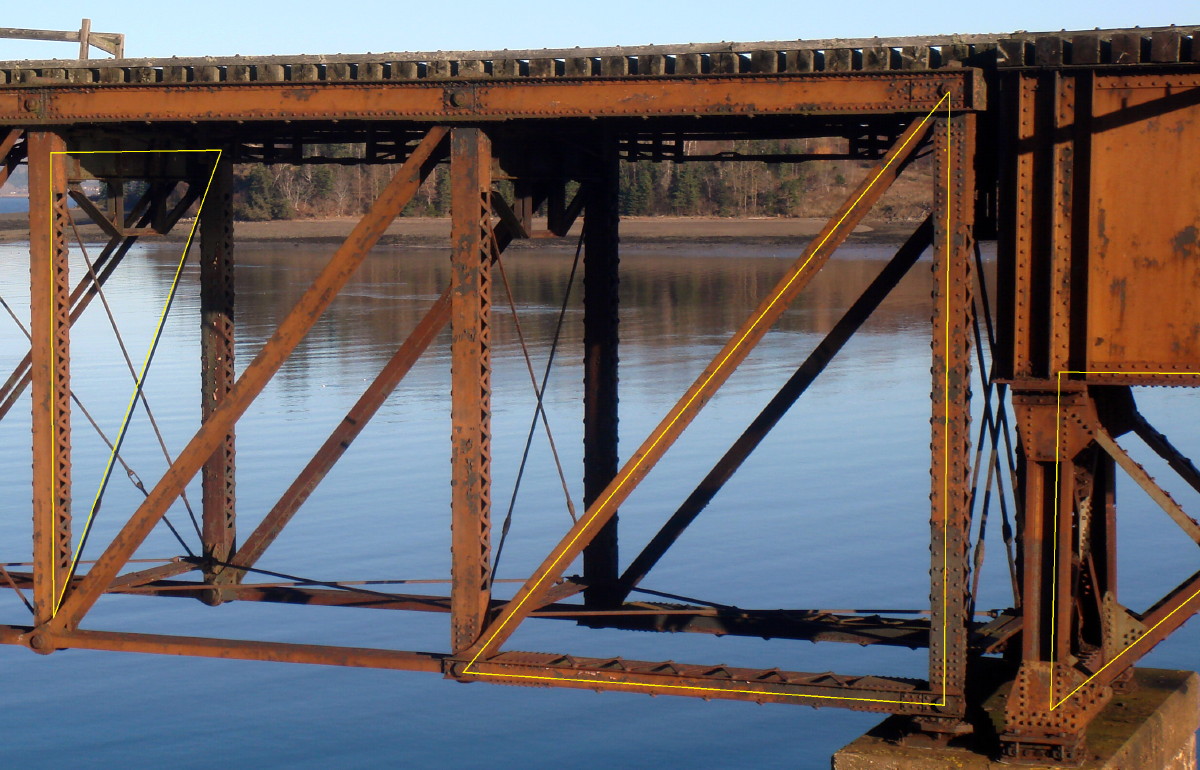
Triangles in structures
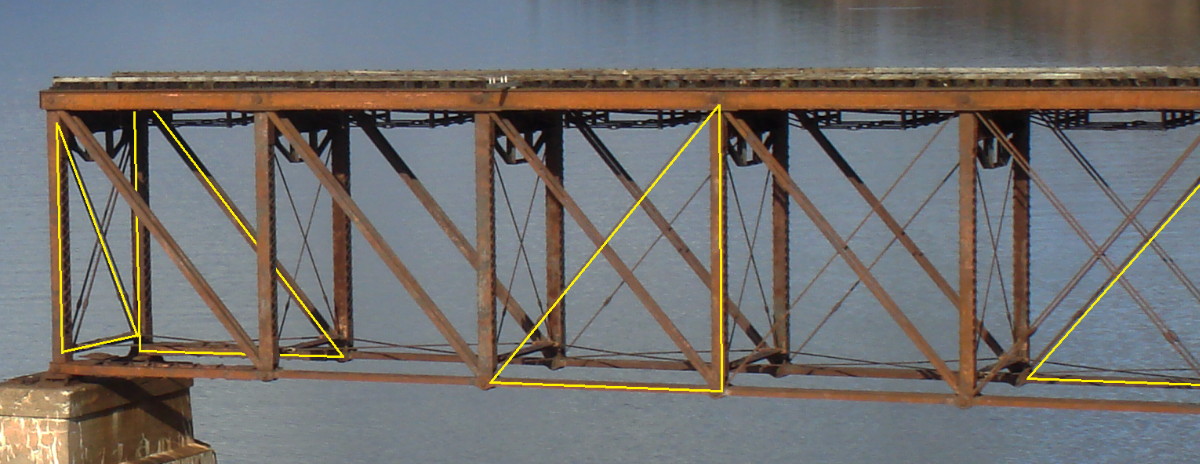
Each of these highlighted triangles was part of the
the mathematical analysis used in the design of this bridge.
 W3C HTML Validation Service http://validator.w3.org/ |
 W3C CSS Validation Service http://jigsaw.w3.org/css-validator/ |