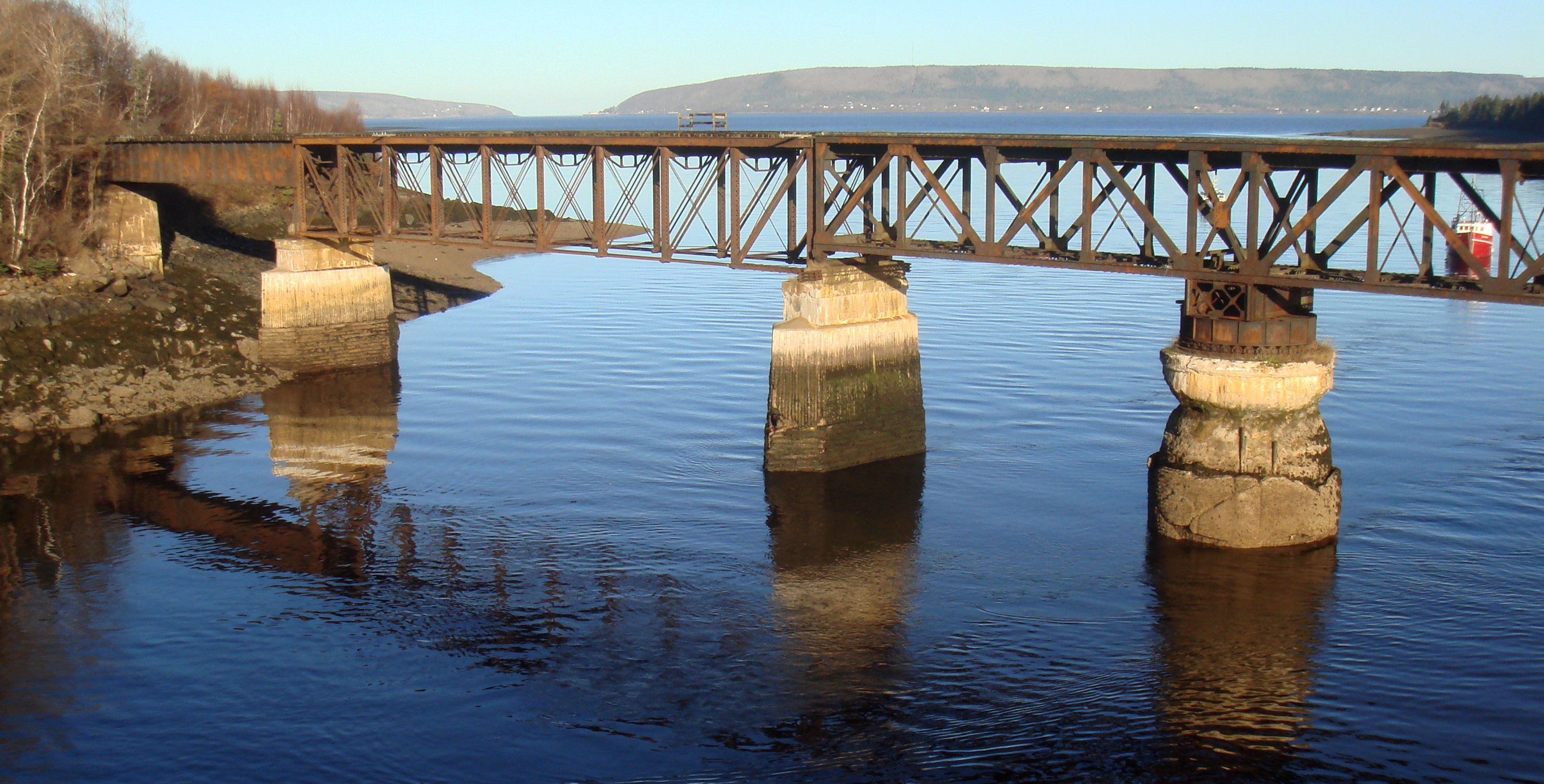
Dominion Atlantic Railway Bear River Bridge 12 November 2010
In November 2010 the bridge structure was still complete.
It appears here the same as it had for the last hundred years
(only the rails and the telegraph wires are missing).
Dominion Atlantic Railway Bear River Bridge 12 November 2010
In November 2010 the bridge structure was still complete.
It appears here the same as it had for the last hundred years
(only the rails and the telegraph wires are missing).

Dominion Atlantic Railway Bear River Bridge 12 November 2010
The telegraph wires are something of a puzzle. The wires were removed years ago,
but there is plainly visible evidence – here shown circled – that they once existed.
These wooden arms, manufactured (complete with transposition brackets and threaded
wood pins for glass insulators) to serve as crossarms on telegraph poles but here
installed as cantilevered extensions of railway ties, were used by the railway to carry
its telegraph wires across this river. For many decades the electric telegraph was a
vital communication system, essential to the safe and efficient operation of trains on
this single-track main line. The telegraph required a continuous electric circuit connecting
each station along the entire length of the railway. On dry land the wires were usually
carried on poles beside the railway, but poles could not be used to cross wide rivers.
To get the wires across this river, the railway installed the wooden arms shown here.
These worked very well along trusses which were permanently in place, but what
about the swing span? The swing span is a puzzle. The telegraph wires would
interfere with the sideways movement of the span. How were the telegraph wires
placed adjacent to the swing span? Remember, the telegraph required a continuous
electric circuit; no gaps could exist anywhere. What to do? It was impractical
to provide arms long enough to reach out horizontally far enough stay clear of the
swing span at all positions. Even if this could be done with very long arms there
was the problem of tall masts on ships as they passed. It wasn't enough to move the
wires horizontally, they also had to be placed vertically high enough to be sure that
they would not be snagged by any part of any ship that might happen to pass this way.
My guess is that the telegraph circuit was taken across rivers, where a swing span existed,
by an underwater cable. Reliable underwater cables, suitable for an electric telegraph
circuit, had been developed in the 1850s and 1860s, years before this railway was built.
My guess is that the telegraph wires were carried across by extension arms on the bridge
only after it was officially recognized that the swing spans in the railway bridges had
outlived their usefulness and the appropriate authorities agreed that they would no longer
be required. From the railway's point of view, the main advantage would be that swing
span operators would no longer be required. The underwater telegraph cables could
remain in place as long as they continued to work, but any time a cable developed
a problem it would not be repaired but would be replaced by the extension arms
installed on the bridge. That's my guess. No doubt there are people who know how
railway telegraph wires were installed at locations where bridges had swing spans.
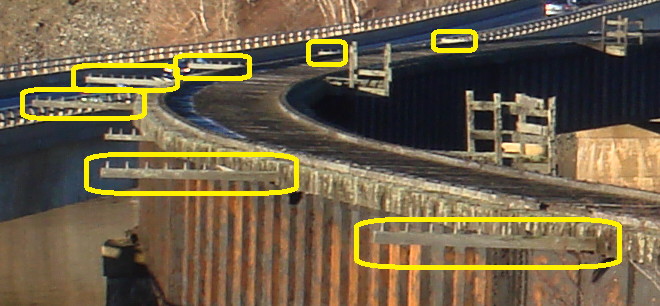
Dominion Atlantic Railway Bear River Bridge 12 November 2010
This is another view showing the telegraph arms along the side of the bridge.
 W3C HTML Validation Service http://validator.w3.org/ |
 W3C CSS Validation Service http://jigsaw.w3.org/css-validator/ |